Entities:
The Key to Successful SEO!

Klaus Huber
4th June, 2021
Since the introduction of the Google Hummingbird update in 2013, entities have become an integral part of search engine optimization, allowing for a better understanding of the context of search queries.
Find out the role that entities play in your SEO success in our article.

What are Entities?
Entities are, by definition, uniquely identifiable, unique things. They can be concrete (e.g., people, places) or abstract. They are individual and have specific attributes attributed to them (color, size, etc.). For example, a specific person or a concept like "peace" can be an entity.
Entities can also be understood as part of the Google algorithm. They enable semantic search, through which Google is nearly perfect in interpreting the context of a search query.
An example:
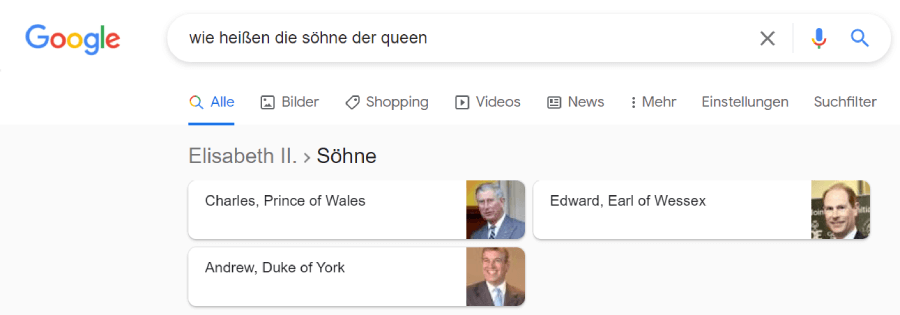
For the search engine to answer this question correctly, it must understand:
- ... that "son" is the male child of a person (in plural form).
- ... that "queen" refers to the British monarch, not just any queen.
- ... who the current British queen is.
- ... that she has children.
- ... their names.
For a machine, this compilation is a great achievement, and Google achieves it through a sophisticated organizational structure.
How are Entities Organized?
Each entity is assigned a URI (Uniform Resource Identifier). This is a combination of letters and numbers, as found in Wikidata. By the way, this database also serves as the basis for search results on Google.
The reason why numerical codes are used is that words are often ambiguous.
Example:
In Wikidata, the dog breed "Labrador" is stored as /m/0km3f. However, someone searching for the term might mean the Canadian peninsula "Labrador" (/m/0g0fd). The individual code makes the assignment unambiguous.
However, the URI alone does not carry any meaning, and Google does not automatically know which entity corresponds to which URI. To solve this problem, there is the so-called RDF (Resource Description Framework). With RDF, logical statements about an entity are formulated, establishing meanings. Two entities (subject and object) are connected with a predicate.

However, such statements are not enough to fully interpret an entity. While the algorithm knows that a Labrador is a dog, it needs to be able to identify what makes a dog and how it differs from other animals.
To achieve a better understanding of an entity, there are ontologies. These can be imagined as a cloud of meanings with entities placed on it. The individual entities are connected by their relationships, forming a kind of network between the objects.
The largest semantic network is the so-called Knowledge Graph, introduced by Google in 2012.
Google's Knowledge Graph
The Knowledge Graph is a vast knowledge database that Google relies on to answer search queries accurately.
This graph consists of edges and nodes. The nodes are the individual objects, including their properties (entities), and the edges are the relationships between these objects.
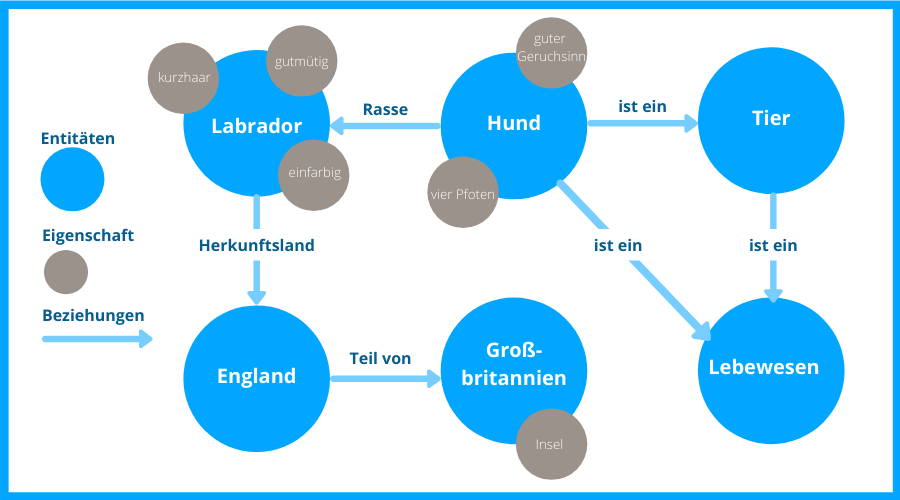
Based on these relationships between entities, Google can identify the search term even if it is not explicitly mentioned. The search engine can draw inferences and in this case, knows that a Labrador is a British dog breed.
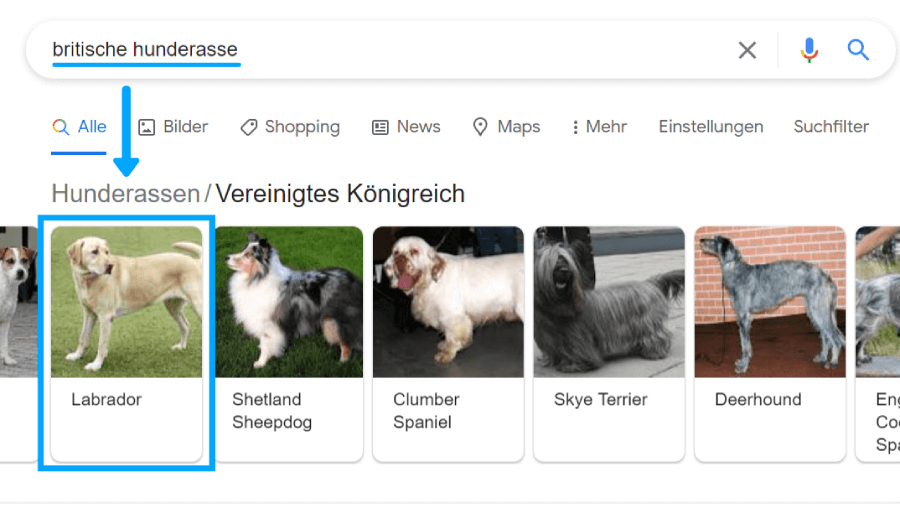
The properties or attributes are crucial for the correct interpretation. The entity "wings" does not reveal whether it refers to the musical instrument or the limb of a bird. While the attribute "made of feathers" clearly points to the bird, attributes like "size" or "color" are not as definitive.
The combination and manifestation of the individual attributes, as well as their relationships with each other, make the entity fully identifiable.
Representation of Entities
Google uses various display formats to present information from the Knowledge Graph. The following entity types are particularly considered by Google:
- Books and book series
- Educational institutions
- Authorities
- Events
- Local businesses
- Movies and film series
- Albums
- Music groups
- Music recordings
- Organizations
- Magazines and journals
- People
- Places
- Sports teams
- TV series and episodes
- Video games and gaming websites
- Websites
Entity Boxes
These usually appear to the right of the search results and refer to people, animals, places, buildings, or similar entities. In the box, the searcher then receives the most important information about the search term.
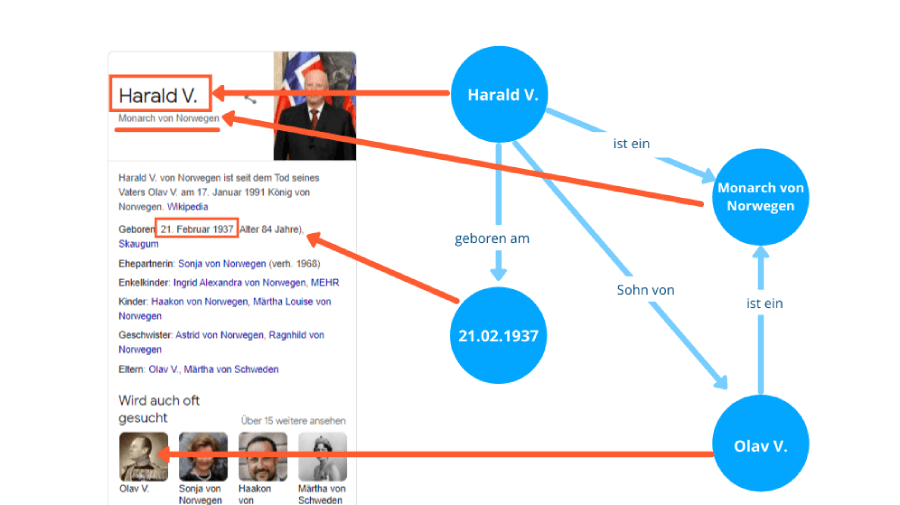
Here is a simplified representation of how Google displays information from the Knowledge Graph.
Know Simple Box
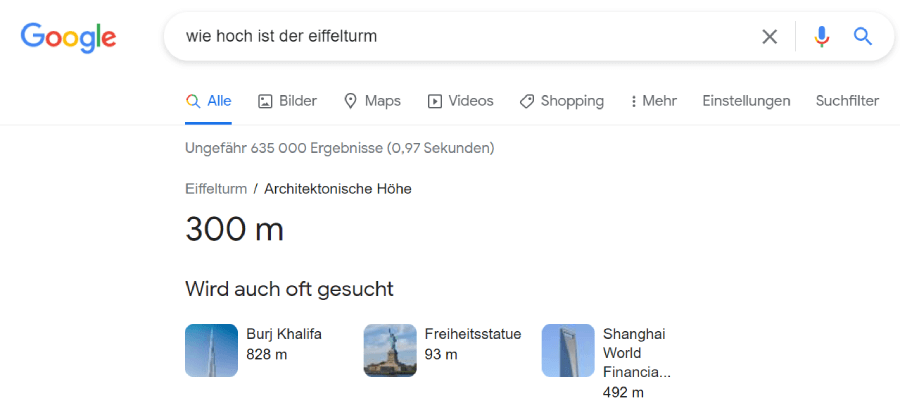
This box appears at the very top of the search results in response to so-called "Know Simple" questions. These can be answered with a few words or a short list.
Carousel
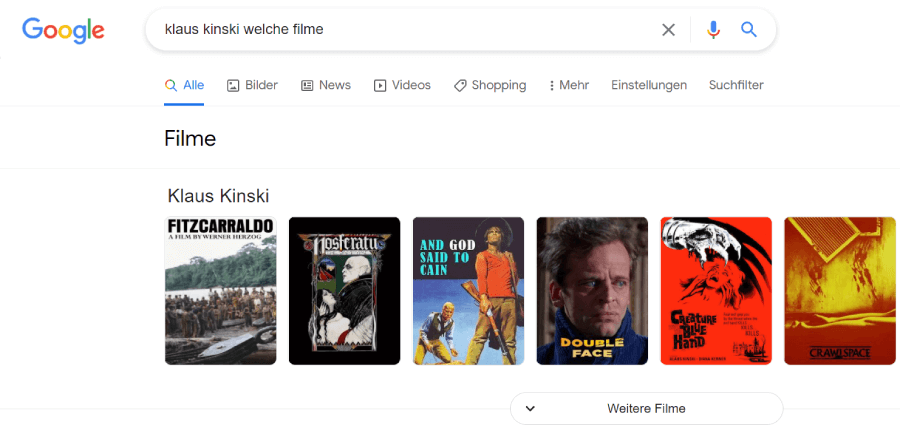
The carousel appears particularly frequently for movies, books, or landmarks. It is a list-like compilation of individual elements that run from left to right. These elements represent the most important entities related to a specific search.
Here, in the example, they are the individual movies of the actor Klaus Kinski:
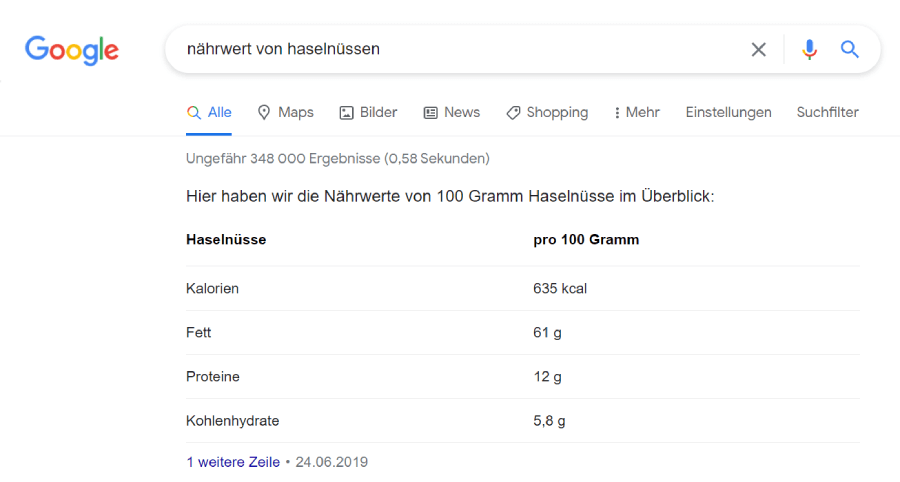
If the answer to a search query cannot be presented with relevant images, a list of facts will be shown. For nutritional information, for example, it makes little sense to display images.
How do I optimize my website for entities?
To optimize your website for entities, you need to establish many contextual references to the respective entities. For this, it's best to orient yourself with your competitors.
You can use the Google Chrome extension called Entity Extractor to identify the entities detected by Google on a webpage. However, this tool only works in combination with the so-called Dandelion API.
To do this, add the extension to your browser and create a Dandelion API account. Through your account dashboard, enter the displayed code into the extension.
Now, when you enter a keyword and click on the Entity Extractor in the upper right corner, Google will show you the recognized entities below:
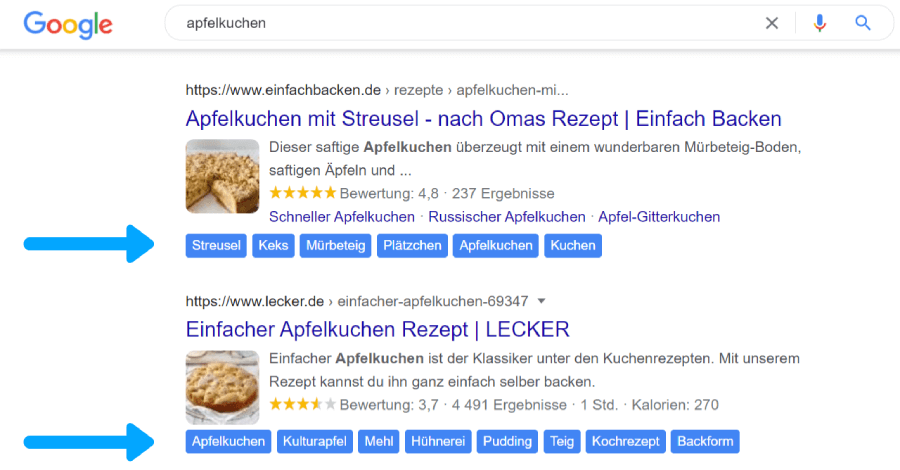
You can also assist the concept of entities using structured data. By using Schema.org, you can make specific information on your website recognizable and thereby simplify the interpretation of content by the search engine.
The Natural Language API by Google allows you to extract entities from texts as well. The API is part of Google Cloud's paid solutions for businesses. However, Google offers a free test area for the Natural Language API, where you can see how Google's entity analysis, content classification, and syntax analysis work.
Conclusion: What role do entities play in SEO?
The best way to consider entities in SEO is to cover a topic as comprehensively and completely as possible. This way, Google learns to establish further relationships and identify entities as such.
Entity SEO is still relatively young, so you should definitely keep an eye on further developments in semantic search.