
Online Marketing:
Increasing Digital Reach by 100% through the Right Content!

Klaus Huber
29.04, 2021
Classic marketing should be familiar to everyone.
In modern companies, however, it is no longer sufficient to rely solely on traditional marketing. The focus has shifted due to the increasing number of digital users - this is where online marketing comes into play.
Because online communication has become so massive, there are naturally many questions from beginners. To put an end to that, this article provides everything you need to know about this complex yet fascinating topic!
Definition: What is Online Marketing?
Online marketing, also known as digital marketing, encompasses all marketing measures on the internet aimed at positioning one's own brand, company, products, or services optimally and generating new customers. The goal is to achieve predetermined objectives, such as increasing reach, awareness, sales figures, etc. It is especially important to establish points of contact with potential customers and create added value for them and the company through online media.
The measures are based on the push and pull principle. With the push principle, companies literally "push" advertising measures onto potential customers to stimulate their buying interest.
The pull principle, on the other hand, works by "attracting" potential customers. They independently search and research products on the internet. Therefore, companies must be present at that moment and attract customers with helpful and audience-oriented content.
Online Marketing Mix
The 4 Ps
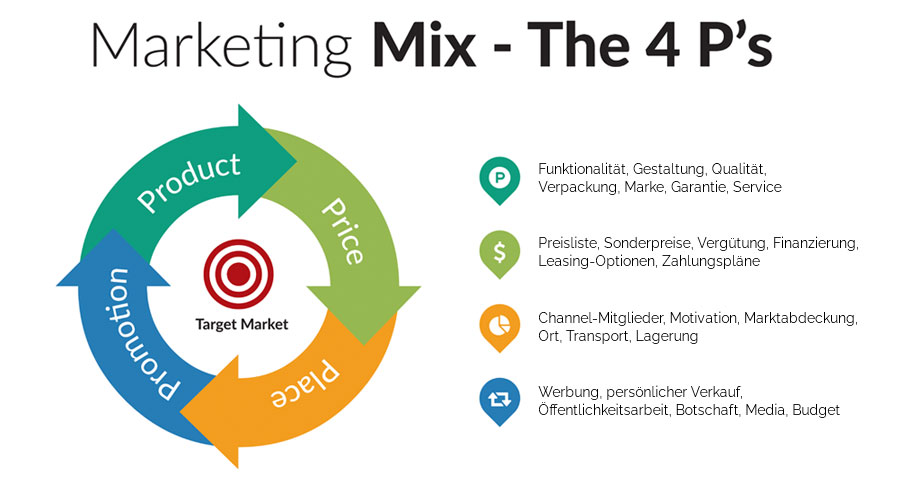
In the classic marketing mix, the famous 4 Ps are used:
Product
The first "P" stands for product policy. Companies make all decisions regarding the design of their sales offerings in product policy. The focus is on the product itself. This includes the product life cycle and the entire product range.
The three central tasks of product policy are product design, service design, and assortment design. Packaging and brand policies are also part of these tasks.
The most important elements of product design include product features, functions, design, packaging, and additional product services.
In service design, decisions are made about whether a product has a warranty and for how long. Other significant aspects include assembly, advice, disposal, etc.
Assortment design deals with the composition of the entire product range. Companies make decisions here about product width and depth. Assortment width describes the number of different product lines, and assortment depth refers to the number of product variations within a product line.
As the name suggests, packaging policy is about suitable packaging for products. They must be packaged in a way that is suitable for distribution and the market, as well as visually appealing to customers. Within brand policy, companies make decisions concerning the connection between brand name and product. In short, brand names and products must match. The goal is to give a product the independent character of a branded item. This branding of products is done using word or image marks.
Price
The next "P" stands for price policy. This involves setting prices. The challenge lies in designing the price so that as many customers as possible buy the product. The price should neither be too high nor too low. There are generally three price strategies that companies can pursue: fixed price strategy, price competition strategy, and price skimming strategy. Each of these strategies aims for a different goal.
In addition, price setting depends on certain factors. These factors are production costs, competition, and the consumer themselves.
Cost-oriented price policy determines the price floor for a product. After all, all production costs must be covered to avoid losses.
Market-oriented price policy focuses on competition and consumers. Companies monitor their competition to keep an eye on all prices, as it becomes difficult to keep up in the market otherwise. In addition, consumer behavior is analyzed to determine the average willingness to pay.
Promotion
The communication policy includes all measures for transmitting information within and outside a company. In short, it plans and controls advertising/communication and determines the target groups.
To attract customers' attention, specific communication policy instruments are used. These instruments range from traditional advertising to sponsorship and social media communication. The main focus is on standing out from the competition, entering new markets, and increasing sales.
As with the other Ps, companies must be aware of their goals. With the help of a pre-determined communication strategy, the desired objectives are set.
Place
The distribution policy deals with all decisions and distribution activities of a product from the producer to the end customer. A product or service must be made available at the right time and place.
The goals of distribution policy include cost minimization for personnel, transport and storage, high influence of the manufacturer on distribution activities, and strong market presence.
It is important for manufacturers to consider which distribution channel, distribution form, sales organization, and sales channel are best suited. Without precise planning in advance, chaos ensues, and the best possible profit remains unrealized.
Regarding the distribution channel, a distinction is made between direct distribution and indirect distribution. Direct distribution occurs when there is no external institution between the producer and the end consumer. Indirect distribution, on the other hand, involves an intermediary institution between the producer and the end consumer.
When it comes to distribution form, the decision must be made whether to use company-owned or external sales organs. There are four sales organs in total: sales helpers, company-owned, company-bound, and external.
The sales channel represents the relationship between all organizations involved in the distribution process.
Extension to the 7 Ps
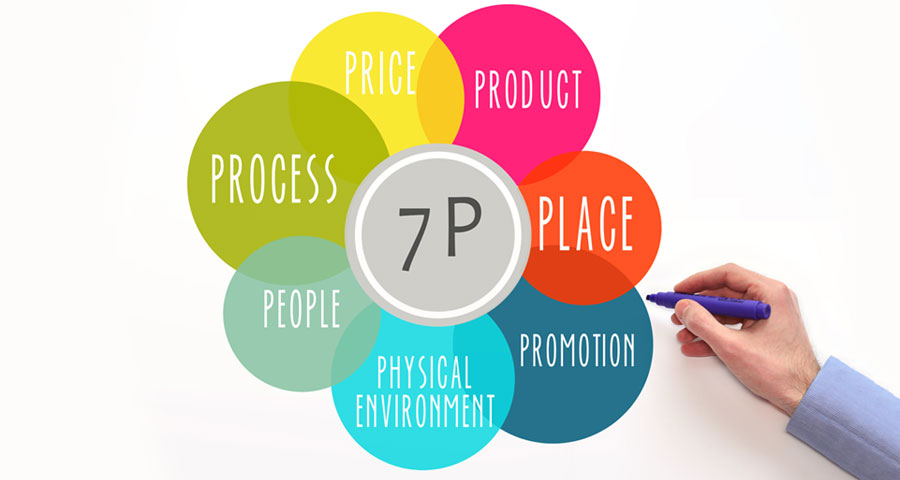
In the Online Marketing Mix, additional elements are added to the usual Ps. These can help companies reach new target groups and increase their reach. Targeted online advertising measures aim to attract and retain customers while simultaneously increasing profits.
Personnel
This P stands for personnel policy and plays a crucial role, especially in the service sector. As services are not as easily assessable as products due to their intangible nature, surrogate indicators are used. These surrogate indicators serve both the qualitative and quantitative evaluation of a service. Finding excellent personnel is fundamental, particularly in the service sector, as customer satisfaction is heavily dependent on the staff.
Process
Process management is not only about purely technical processes. A significant factor is customer-oriented business processes. As a result, continuous monitoring of all company processes and the constant adherence to corporate goals are essential contents of process management.
Physical Facilities
The last "P" stands for facilities policy. The physical environment of a product or service contributes significantly to the customer's experience. Especially in the service sector, the facilities are of high importance since perception is not easily influenced, as is the case, for example, with a product featuring an upscale design. Therefore, the environment should be designed in a way that subconsciously influences customers positively – the more appealing the ambiance, the more comfortable the customer feels.
Some tools include: type of building/architecture, design, appearance, etc.
Goals of Online Marketing
An online marketing strategy begins with defining your goals.
When setting online goals, it is essential to ensure that they are always aligned with overall marketing objectives and contribute to achieving the company's goals.
Here is an overview of possible goals and key performance indicators:
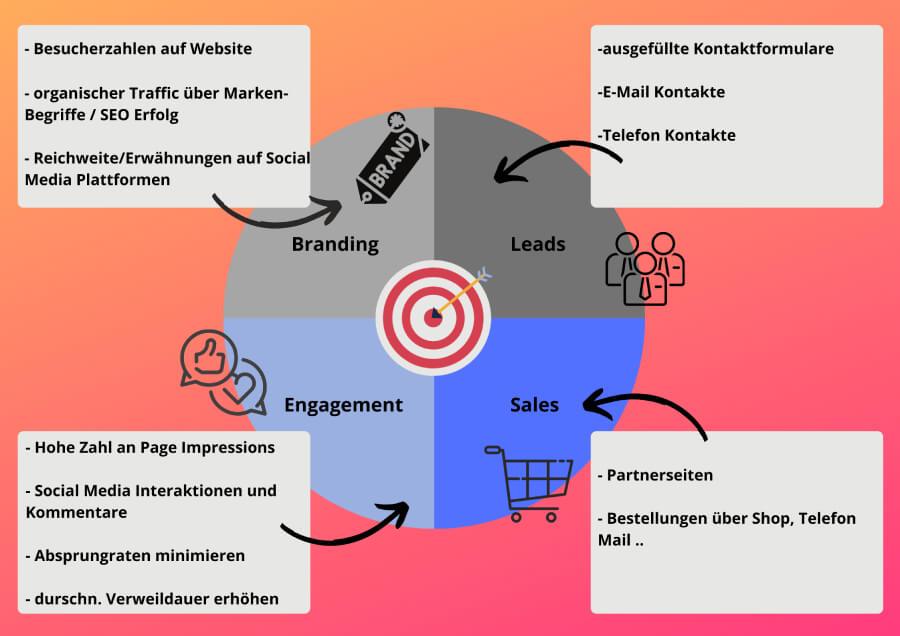
Just like general marketing measures, the goals of online marketing may include increasing sales, acquiring new customers, and customer retention, among others.
SMART Goals
In general, it is essential to have SMART goals (Specific, Measurable, Achievable, Relevant, Time-bound). In the marketing field, setting SMART goals is crucial because it allows for more precise planning and a better understanding of your objectives. This helps prevent premature termination or a poor start to your initiatives.
The SMART acronym is broken down as follows:
Specific:
Goals should be clear and specific to avoid ambiguity.
Measurable:
The achievement of a goal must be measurable. This means that a specific outcome should be defined in advance. With a measurable outcome, success can be assessed using tangible data points.
Attainable:
A goal must also be realistic. If it is far beyond what is feasible, disappointment will be significant in the end. However, the goal should still be challenging - just not unrealistic!
Relevant:
A goal should be attractive and accepted by all stakeholders. It should be formulated in a positive manner to keep team members motivated.
Time-bound:
It is beneficial to set a deadline for achieving a goal. This deadline helps with motivation and implementation. Setting concrete milestones is especially helpful as they divide the project into stages with measurable interim targets.
An example of a non-SMART goal:
"We increase our profit."
This goal is neither measurable nor time-bound.
An example of a SMART goal:
"We increase our profit by 5% compared to the previous year by the end of the calendar year 2021."
The History of Online Marketing
The time when functional search engines and other reliable ways to find online shops or websites did not exist is long gone.
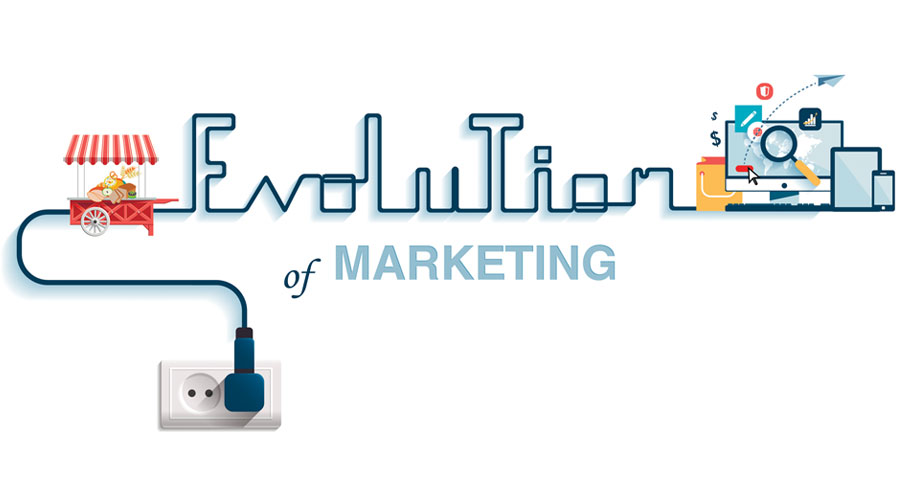
William J. Tobin is considered the inventor of online marketing. As early as 1989, he created a service that operated affiliate marketing. This service was active until 1996.
In 1994, a company called "CDNOW" developed a service that allowed website owners to publish reviews of music albums on their site. Visitors to these websites were directed to the CDNOW website via a backlink, where they could then purchase the desired CD. In return, the website operator from which the buyer came received a commission. CDNOW is considered the first provider of affiliate programs.
In July 1996, Amazon launched its affiliate program and filed a patent for the concept of affiliate programs for commercial websites. This model had a significant impact on the market, and today, Amazon is the most well-known representative. Since then, the market for affiliate marketing has grown rapidly and become heavily populated.
The 90s were dominated by Web 1.0. For a long time, companies used the internet solely as an advertising platform, publishing pure advertising content with no means of communication between users and advertisers. Since the year 2000, we have seen the advent of Web 2.0. Users and advertisers could now interact, and the first social networks were launched. In 2020, we were on the threshold of transitioning from Web 3.0 to Web 4.0. Semantic web technologies were central to Web 3.0, and today, it's artificial intelligence - the beginning of Web 4.0.
The Disciplines of Online Marketing
The key disciplines of online marketing can be divided into the following:
Search Engine Marketing
Search Engine Marketing (SEM) consists of two areas: Search Engine Optimization (SEO) and Search Engine Advertising (SEA).
Search Engine Marketing encompasses all activities aimed at achieving better visibility in search engine results, such as Google.
Search Engine Optimization aims to improve the ranking in organic search results. It is divided into Off-page and On-page optimization. Off-page optimization refers to all measures that can be taken outside the website to improve search result rankings. On-page optimization, on the other hand, includes all measures that can be implemented on the website itself.
In contrast, Search Engine Advertising refers to placing paid advertisements in the search engine's result pages.
Social Media Marketing
Social Media Marketing involves strategies and tactics used by companies or organizations to advertise on social networks such as Facebook and Instagram. This includes running paid advertisements or creating a company page on various social networks. Having a company page with many followers and likes quickly draws potential customers' attention.
Due to the increasing relevance of social media, Social Media Marketing is becoming more and more important for companies. According to a Statista study from 2020, 78% of companies worldwide stated that the decisive benefit of Social Media Marketing is increased attention.
However, it is essential to note that social networks should only serve as a supplement to your own web presence and not replace it.
Content Marketing
Content Marketing is a strategic marketing approach that focuses on the creation and dissemination of valuable and relevant content. The goal is to attract and retain a clearly defined target audience. Users should derive added value from this content. Relevance and consistency are key to success. With excellent content, you gain attention, generate new customers, and encourage them to return.
The focus is not on direct sales, but on the production of helpful information.
Affiliate Marketing
Affiliate Marketing is a sales concept in which an affiliate (partner) advertises a third-party company's products or services on their own website and receives a commission for it. This commission is earned by the affiliate only if the advertising leads to a successful outcome.
Both sides benefit from this concept: while the affiliate earns money by creating affiliate links, the merchant gains more reach and profit.
Display Advertising
Display Advertising refers to graphic advertising on the internet, in apps, or on social media using banners or other ad formats. It is often referred to as banner advertising.
The goal of banner advertising is to build or strengthen the brand. Potential customers are encouraged to click on the ads and then perform an interaction, such as placing an order, on the company's website. To ensure that customers are shown only relevant ads, companies use ad servers. These ad servers are used for delivering and measuring the success of the advertising materials.
Mobile Marketing
Mobile devices such as smartphones and tablets are an integral part of everyday life today. Hardly anyone leaves home without their smartphone in their pocket. For this reason, accessing digital content on mobile devices must work smoothly. This is where Mobile Marketing comes into play: users are now addressed on their mobile devices.
Online shopping is no longer limited to desktop computers but is increasingly carried out on mobile devices due to convenience and the ability to shop on the go. Therefore, web design must meet all requirements and adapt to different screen sizes. Browsing the internet must be made as pleasant as possible so that the interaction between provider and consumer does not stall.
E-Mail Marketing
E-Mail Marketing involves the sending of promotional emails through traditional newsletters or informational emails. This email contact is used for acquiring new customers and retaining existing ones.
The customer does not have to search for information; they receive it via email. The goal is to generate interest in new products or services. It is crucial that the customer does not feel annoyed because no one appreciates annoying spam emails. As explained earlier, the content delivered should provide value to the customer and not cause annoyance.
Personalized emails are particularly successful because the customer is addressed directly - it creates a more personal connection.
Multichannel Marketing
Multichannel Marketing aims to reach individuals in the target audience through different communication and sales channels. These measures can be both online and offline - the right mix is essential!
Multichannel Marketing can help build a brand more effectively or make better use of targeting. It can also positively influence customer retention through the various channels. The more present, the better, as brand presence becomes ingrained in customers' minds.
Die wichtigsten Kennzahlen
In Online Marketing, a distinction is made between primary and secondary key performance indicators (KPIs). Additionally, there are other groups of metrics, such as social media or e-commerce metrics. This article will focus only on primary and secondary KPIs.

Primary KPIs directly relate to the predetermined goals. They indicate how cost-effective your planning was and are therefore particularly important for the balance sheet.
Number of Conversions: Conversions can include sales, email contacts, downloads, or other leads.
Conversion Rate: It describes the ratio of clicks or visits to the achieved conversions.
CPA: This metric represents the cost per acquisition. It is also known as Cost per Order (CPO) and Cost per Lead (CPL).
ROI: ROI stands for Return on Investment and describes the ratio of profit to the capital invested. It is one of the most important economic metrics.
ROAS: ROAS stands for Return on Advertising Spending and describes the ratio of marketing budget spent and the revenue generated as a result.
Secondary KPIs
Secondary KPIs indirectly relate to the goals. They provide information and insights into the entire process from information gathering to purchase. They help identify both weaknesses and strengths.
Visitors: Number of website visitors
Unique Visits: Number of unique visitors
Rate of Returning Visitors: A high rate of returning visitors indicates a loyal user base. However, this rate should not be higher than the number of absolute visitors, as it could indicate a lack of new customer acquisition.
Bounce Rate: This metric measures how many website visitors left the site without interacting with it. A high bounce rate suggests visitor dissatisfaction, as they might not have found what they were looking for or expected.
Page Impressions: Number of page views per visitor. A high number of page impressions indicates high visitor engagement.
CTR: Click-Through-Rate represents the number of clicks on advertising banners in relation to the total number of impressions.
Dwell Time: Dwell time represents the average time visitors spend on the website. It can also be used to measure the quality of a website; if a visitor leaves a page after a few seconds, it may indicate low content quality.
Evaluating KPIs
To realistically assess KPIs, they should be observed over an extended period. Short-term fluctuations are normal and should be disregarded.
Additionally, the business model is crucial for evaluating KPIs. Depending on the business model, the assessment may depend on the average order value or the conversion rate. Individual goals and industry play a significant role, making it impossible to have a universally valid evaluation of online marketing KPIs.
The Most Important Social Media Platforms
Social media platforms have gained significant relevance for businesses in recent years. Especially during the COVID-19 pandemic, many companies realized the importance of engaging with social media to stay connected with their target audience and continue offering their products.
But what are actually the most important social media platforms? This question is currently on the minds of many companies, and it is indeed justified:
It depends entirely on your company and the type of content you want to provide, as not every platform is suitable for all businesses.
To make the right choice for your company, here is a list of the most important social media platforms. Additionally, we'll explain the type of content and target audience they are best suited for.
Facebook:
Facebook ranked first in January 2020 among the world's most used social networks. Despite claims that "Facebook is dead" or "Facebook is only for the older generation," they remain the leaders in social networks. So, don't be misled by such statements. Moreover, Facebook encompasses a wide range of target audiences: not only "older individuals" but everyone!
For your company, this means that Facebook is particularly suitable if you have a broad target audience. Whether it's text, images, videos, or live streams - everything can be shared. Additionally, you can directly interact with your customers under your posts. This way, you can receive valuable feedback and quickly respond to potential complaints.
But beware:
Facebook has deliberately reduced the visibility of company posts in recent years, as they primarily aim to be a platform for friends and family.
Nevertheless, there are still ways for your followers to see all your posts in their newsfeed. To ensure that they can see all posts from their favorite pages, they need to select "See First" in their newsfeed settings.
YouTube:
YouTube secured the second position among the most used social networks. If your company plans to build a video-based content strategy, this is the perfect platform for you.
YouTube now functions as a search engine as well, providing answers to any problems people may encounter.
You can effectively use YouTube for marketing purposes, such as promoting new offers or creating videos that directly engage potential customers and answer all their questions. Even if your focus is on informative content, the "entertainment factor" should not be overlooked. This way, you ensure that your company stays in the minds of your customers. The key is to make sure these videos are related to your company and provide added value.
A challenge lies in creating regular content to stay relevant, as the competition is fierce.
As for the target audience, it is similar to Facebook. It is diverse and provides suitable content for every age group.
Instagram:
In third place, we find the subsidiary platform of Facebook - Instagram. This platform is popular among all age groups. The most represented age group of Instagram users worldwide falls between 25 and 34 years, but businesses are also well-represented here.
Instagram now allows users to upload not only images but also videos with a maximum length of 60 seconds. In 2020, the platform was expanded with "IGTV," which enables videos of up to 60 minutes in length.
Through the story feature, businesses have the opportunity to communicate with their customers and keep them up to date. Announcing news works best here.
However, you should primarily focus on posting new image and video content because that's the first thing users see when they visit a new Instagram profile. If there's no content visible on your profile, you won't be able to gain followers. So, offer new and high-quality content regularly. It does require some effort, but it's worth it!
Each post should also be accompanied by hashtags to increase reach. Relevant hashtags lead to more users discovering your channel.
TikTok:
The creative platform from China has grown as strongly in recent years as few others. Short videos are uploaded here, which can be enhanced with music, filters, or other features.
Generally speaking, TikTok is considered a platform for a younger audience and is mostly used for entertainment purposes. Nevertheless, you can also gain reach here if you're willing to engage with the platform's theme. That's why you need to closely examine your target audience beforehand to determine if a platform like TikTok is even suitable.
If you're looking for young talents, then this platform is very well-suited for directly addressing the younger generation.
Pinterest:
Pinterest can be understood as a kind of large pinboard where users "pin" inspirations and ideas to their own boards. The "pins" are visible to all platform users and can be repinned by others.
Pinterest is interesting for businesses because the reach of their products can be increased through recommendations from others. People who are convinced by a product will likely pin it to their own board. So, you benefit from users of the platform indirectly advertising for you.
Especially on an SEO level, Pinterest offers a great opportunity to increase your visibility since pinboards appear prominently on the first page of Google. Even elaborately crafted blog posts cannot compete.
The target audience is predominantly female. However, that doesn't mean the male audience on the platform is entirely irrelevant - there has been a rising trend in this group in recent years.
Snapchat:
Snapchat is a platform for sending photos and other media that are only visible for a certain number of seconds before being automatically removed. Similar to Instagram, there's also the story feature, which is very popular.
Users of Snapchat are very young - mostly in their early teens.
By now, the platform has firmly established itself in the daily lives of the younger audience. Those who have been using Snapchat since its beginning in 2013 have grown with the platform, meaning they have become older. This fact is intriguing for companies since with increasing age, purchasing power also rises. Even though the overall target audience is still extremely young, they are the consumers of tomorrow!
The story feature provides the opportunity for companies to present themselves and interact with their customers. With the various fun features, you can also showcase your humorous side, which is well-received by users.
Twitter:
On Twitter, you have the ability to compose so-called "tweets." In simple terms, you can add your "two cents" to any topic.
For this reason, a wide range of people can be found on Twitter - from young to old, everyone is represented.
The significant advantage of Twitter is that interaction with friends or customers is not only personal but also very rapid.
Since conversations are happening everywhere, you need to be very quick and compose multiple tweets per day to stay relevant. By using hashtags, you can additionally increase your reach. It's essential to not just tweet anything but to think about how you can best reach your target audience. Present yourself and your company's values as authentically as possible and try to cleverly package your offerings.
Major companies like Adidas are particularly active on Twitter. In fact, Adidas is the second most visible brand on Twitter globally, right behind Nike. They achieved this through various video ads, which helped them achieve maximum brand awareness.
LinkedIn:
LinkedIn is primarily a business network where industry experts can exchange ideas. Additionally, companies have the opportunity to showcase their products without it feeling like typical social media advertising.
However, LinkedIn is gradually evolving into a social media platform, as evidenced by the increasingly private feeds. However, this change is not seen as negative because it has led to an increase in the number of users.
As a company, you can share various types of content with your network, such as studies, videos, articles, or upcoming events. For potential customers and network partners, it is essential to regularly maintain your profile, just like on other platforms.
Developing an Online Marketing Strategy
To successfully engage in online marketing, you naturally need a strategy. You've already taken the first step by defining your goals, and now you face the task of devising a plan to achieve them - after all, working blindly has never proven effective.

Since there are numerous tools available to realize your specific goals, there are just as many opportunities to take risks and lose money with the chosen option.
Below are the further steps to develop an online marketing strategy:
- Target Audience Analysis
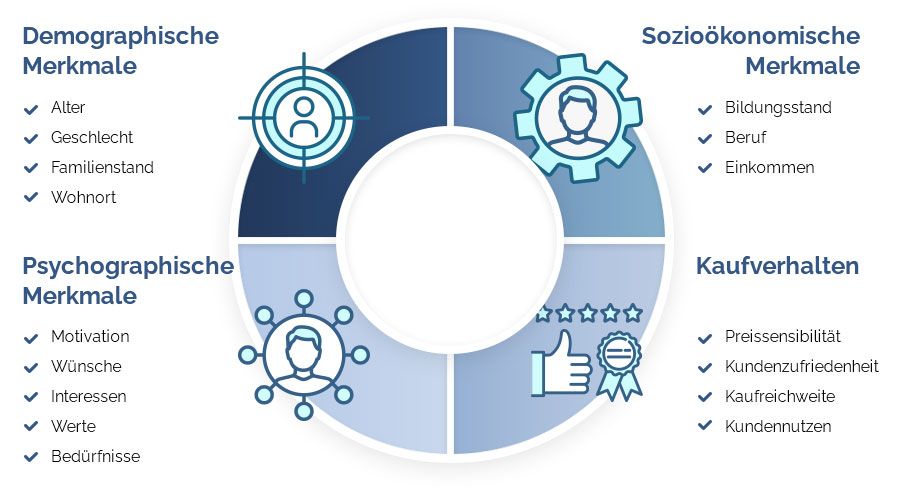
The first step is to identify the right target audience. With their help, you can effectively implement your online marketing campaign. The analysis of your target audience involves using specific segmentation variables that are independent of the company's industry.
The segmentation variables:
- Selection of Online Marketing Channels and Measures
In online marketing, there are many channels and measures to address your target audience in a goal-oriented manner. Therefore, it is not always easy to determine which ones are best suited for your company. It is essential to carefully conduct the first step of target audience analysis and then select appropriate channels based on the data collected. You can review the most important measures and social media channels in the previous chapters.
- Monitoring and Adjustment
In the final step, you need to record, observe, and adjust your results regularly. By analyzing the results, you will be able to identify certain patterns among your customers, which will help you optimize your online marketing strategy. You will quickly notice what worked well and what may not have been as successful. Especially by analyzing online marketing metrics, you can evaluate how successfully you achieved your goals.
Conclusion
The world of the internet offers a huge range of new marketing measures. Online advertising has become a daily routine for most companies, and not without reason:
Through online marketing, you can precisely target your desired audience and turn them into loyal customers. Additionally, the implemented measures can be directly measured, which means it takes less time to get back on the right track and fix mistakes.
Embrace new, creative formats and keep your goals in sight.
Innovative ideas dominate the digital world!
Need Help? - We Are Here for You!
Do you need SEO assistance or want to know if your online presence can be further optimized? - Then request our free SEO check and be on the safe side. After a comprehensive analysis of your website, you will receive a detailed SEO report and concrete action suggestions for optimization.