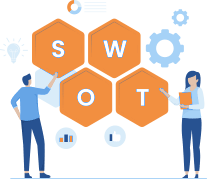
SWOT Analysis:
How to Use the Model for Your Company!
Klaus Huber
14th June 2021
The promising SWOT analysis is applied in strategic corporate planning and examines all Strengths, Weaknesses, Opportunities, and Threats. It is one of the most commonly used models.
But how is the SWOT analysis exactly conducted and evaluated? And what strategies can be derived from it? - All these questions will be answered in the following article.
Definition: What is a SWOT Analysis?

The S-W-O-T analysis is an important component of the business plan. The acronym, originating from English, stands for:
- Strengths
- Weaknesses
- Opportunities
- Threats
The analysis reveals the strengths and weaknesses of a company, identifies opportunities, and identifies potential risks. Many companies use this approach for their strategic planning to determine their own position and derive effective marketing strategies.
The analysis of strengths and weaknesses takes place within the scope of an internal company analysis, while the examination of opportunities and threats relates to the description of the external environment, i.e., the external analysis.
Objectives:
The goal of the SWOT analysis is to develop strategies to leverage identified strengths and opportunities and minimize weaknesses and risks. Implementing appropriate measures leads to improved positioning of the company. Only through comprehensive analysis and strategy development can successes be achieved and set goals reached.
In addition, the SWOT analysis serves for the resource and budget planning of a company, as past misplanning and future prospects can be better understood and assessed.
Applications
The SWOT analysis is not only used in strategic management. It also serves as a helpful planning method in many other situations.
Project Management:
The SWOT analysis can be used in projects to collectively assess the current situation and discuss appropriate actions within the team.
Marketing Planning:
External factors play a crucial role, especially in marketing. Market potentials are evaluated using the analysis.
Start-Ups:
When starting a new venture, a well-developed business plan is needed. Since the SWOT analysis is part of this plan, it is also used in start-up planning.
Self-Management:
Especially during career reorientation, self-assessment can be very helpful: Where are my strengths and weaknesses? Where do I see potential for action? In which areas can I develop further?
Origin
The SWOT analysis originated in 1960 at Harvard Business School. It was developed for application in companies and remains in use until today. According to some sources, its history even dates back to a time before the birth of Jesus:
The Chinese general, military strategist, and philosopher "Sunzi" said: "If you know the enemy and know yourself, you need not fear the result of a hundred battles. If you know yourself but not the enemy, for every victory gained, you will also suffer a defeat. If you know neither the enemy nor yourself, you will succumb in every battle."
The core idea:
Only those who are aware of their strengths and weaknesses and know the challenges they must face will be successful.
This idea can also be applied to companies - To run a successful business, one must know both their own company and their competitors.
The SWOT Categories
Strengths and Weaknesses
Strengths refer to the core competencies of a company. They are characteristics and factors that provide an advantage in competition or compared to competitors.
Weaknesses, on the other hand, are characteristics and factors that represent a disadvantage in competition or compared to competitors.
Opportunities and Threats
Opportunities are potentials that arise for the company in the environment or market due to developments or changes. Opportunities often arise from a company's strengths.
Threats are dangers/threats in the environment or market that can weaken the company or lead to losses. Weaknesses, in particular, can quickly turn into risks if not addressed promptly.
Possible Questions for Identifying Strengths/Weaknesses and Opportunities/Threats:
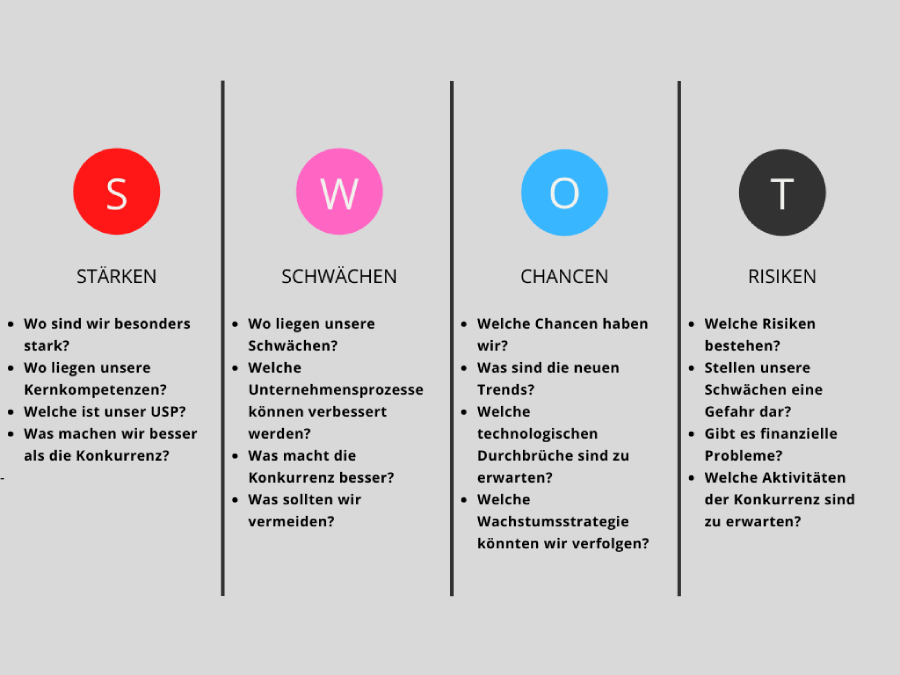
Important: Only the truly relevant strengths/weaknesses and real opportunities/threats should be identified. Strengths/weaknesses are relevant only if they have an impact on the company's competitive position. Opportunities must be realistic for the company, and risks are only relevant if they are challenging to combat.
Creating a SWOT Analysis - Step by Step
1. Goal Definition
Before even starting to create a SWOT analysis, you need to consider your fundamental objectives. Developing effective strategies and measures can only be successful when the data is related to a specific goal.
It is important to ensure that the goals are not too general but rather clearly defined and measurable!
2. Company Analysis (Internal Analysis)
The strengths and weaknesses analysis pertains to the company itself and is therefore also known as company analysis or microenvironment.
At this stage, a kind of self-assessment is conducted: The company is responsible for its own strengths and weaknesses and is therefore capable of positively or negatively influencing them. The core competencies and good reputation must be earned by the company itself.
You must ask yourself what your company stands for and what sets it apart. On the other hand, you must also become aware of your weak points and disadvantages.
3. Environmental Analysis (External Analysis)
In the external analysis, the business environment is examined, also known as the macro-environment.
Opportunities and Threats arise from market dynamics and can constantly change due to technological, social, and environmental factors. Potential external threats must be monitored to enable timely strategy adjustments. The activities of direct competitors can significantly impact your company, both positively and negatively. Therefore, it's important to keep track of what your competition is doing.
The same applies to opportunities: Identifying opportunities early allows you to capitalize on them and gain a competitive advantage.
In this context, particularly important is the examination of new trends in your industry, as a new trend always represents an opportunity. Additionally, you should also keep an eye on technological or legal changes that may affect your company.
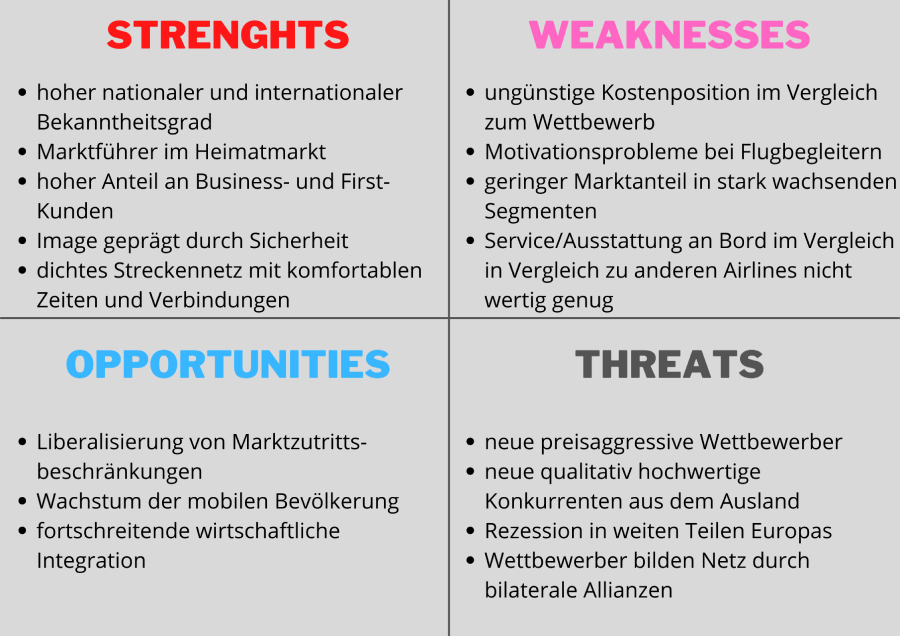
Example SWOT Analysis: Airline Company
4. The SWOT Matrix and the Resulting Strategies
Using the SWOT Matrix, connections between the strengths and weaknesses of the company and the opportunities and threats in the environment can be identified and translated into strategies. The combination of the company analysis and environmental analysis leads to the derivation of strategic recommendations. There are four strategies in total:
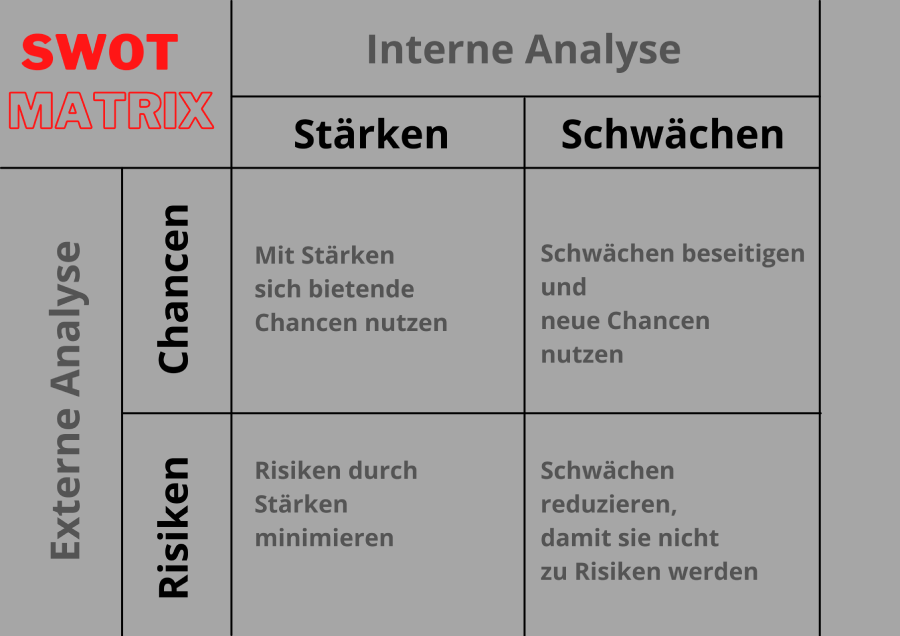
The initial letters of each strategy provide a hint about the areas covered in the SWOT analysis:
The S-O Strategy: "Expand"
Utilize the strengths of the company to capitalize on available opportunities. This strategy is crucial for exploring export and investment potentials that align with the company's strengths.
The S-T Strategy: "Secure"
Use the strengths of the company to neutralize or minimize threats that endanger it. The strengths contribute to securing the company.
As this strategy aims to neutralize risks, it is also referred to as a neutralization strategy.
The W-O Strategy: "Overcome"
In this strategy, the company's weaknesses are addressed to capitalize on new opportunities. In other words, weaknesses are transformed into opportunities.
The W-T Strategy: "Avoid"
Eliminating weaknesses not only enables the company to seize new opportunities but also reduces risks.
Weaknesses that are swiftly addressed cannot become threats.
5. Development of a Business Strategy
The final step in the analysis is the group discussion of the results and the development of a goal-oriented business strategy and corresponding measures.
Strategies for the example of the airline company:
S-O Strategy:
- Establishing a presence in new markets
W-O Strategy:
- Improving core services
S-T Strategy:
- Establishing a low-cost airline
- Creating a new hub in key markets
W-T Strategy:
- Establishing a low-cost airline
- Creating bilateral alliances
Problems and Errors
During the creation of the SWOT analysis, problems and errors frequently occur, which should be avoided at all costs. Often, these issues arise right from the start and persist throughout the entire analysis.
If you are aware of these errors beforehand, you can optimize your work processes accordingly.

The following errors commonly occur:
- The SWOT analysis is conducted without a clearly defined goal: Undertaking the analysis without a plan leads to no results and does not allow for monitoring of success. Therefore, it is crucial to establish a target state from the beginning.
- The states of the SWOT analysis are confused with strategies: The SWOT analysis is not a strategy planning tool! It merely describes the states. Strategies are derived later in the planning process.
- Prioritization is neglected: Measures are neither decided nor implemented.
- The SWOT analysis is misused: Only desired information is included.
- No clear distinction is made between strengths and opportunities or weaknesses and threats: This leads to an inability to draw conclusions and make decisions.
- The level of research effort is reduced.
Advantages and Disadvantages
The SWOT analysis is a proven tool; however, it is not without its drawbacks. Apart from the problems and errors, there are also some disadvantages you should be aware of:
Advantages:
- Simple implementation
- Visually compelling
- Quick overview of the current company situation
- Enhancement of internal communication
Disadvantages:
- Strengths/weaknesses and opportunities/threats are purely subjective evaluations
- External factors are challenging to determine
- High research effort
- Regular renewal is necessary
Conclusion - A Valuable Model with Overcomable Weaknesses!
The first rule in creating a SWOT analysis is: Be honest!
Naturally, presenting an unbiased analysis is not an easy task. However, it is essential for companies to reveal their weaknesses and not sugarcoat reality. It benefits no one to do otherwise.
With a little practice and discipline, it is entirely possible to create an objective picture of the company's situation. External analysts can be involved to offer a different perspective on the current state. When the analysis is conducted correctly, it becomes a powerful tool for deriving strategies and actions.
For long-term success, regular reevaluation of the analysis is necessary. A one-time creation is not sufficient. However, this also has a positive aspect - with each repetition, you learn and improve the process further. The SWOT analysis convinces not least due to its simple applicability.