
Content Marketing 2022:
Everything You Need to Know about Content Marketing!

Klaus Huber
29.07, 2021
As Bill Gates once said back in 1996: "Content is King.""
The trend towards Content Marketing continues to be strong in the year 2022. In this article, you will be thoroughly and vividly explained why this is the case and which content formats are of particular interest this year.
Definition: What is Content Marketing?
Content Marketing is considered a crucial factor for the long-term competitiveness of any company online and is an integral part of corporate communication. Especially with the ongoing digitalization, the topic of Content Marketing is gaining increasing importance.
Content refers to information. Content Marketing, therefore, means producing content. More precisely, it is a marketing technique that aims to address the target audience with non-commercial content to convince them of the value of the company and its offerings. As a result, new customers can be gained or retained. The mentioned content can be informative, advisory, or entertaining.
Why Content Marketing?
The significance of the Internet is rapidly increasing, and hardly any company can ignore Content Marketing as traditional advertising methods are no longer desired.
Content Marketing can, for example, promote brand building, boost lead generation, or support search engine optimization (SEO). Especially in the latter area, it is receiving more and more attention. This is because customers not only search for content solutions to their problems or needs through major search engines but also conduct their research. If a company provides content that creates real added value, it can attract new customers in this way. Classical online advertising is now unwelcome, leading many people to block or ignore it. Pushy calls to buy only lead to short-term success. Content Marketing, on the other hand, aims for long-term relationships and gaining customers' trust.
Goals
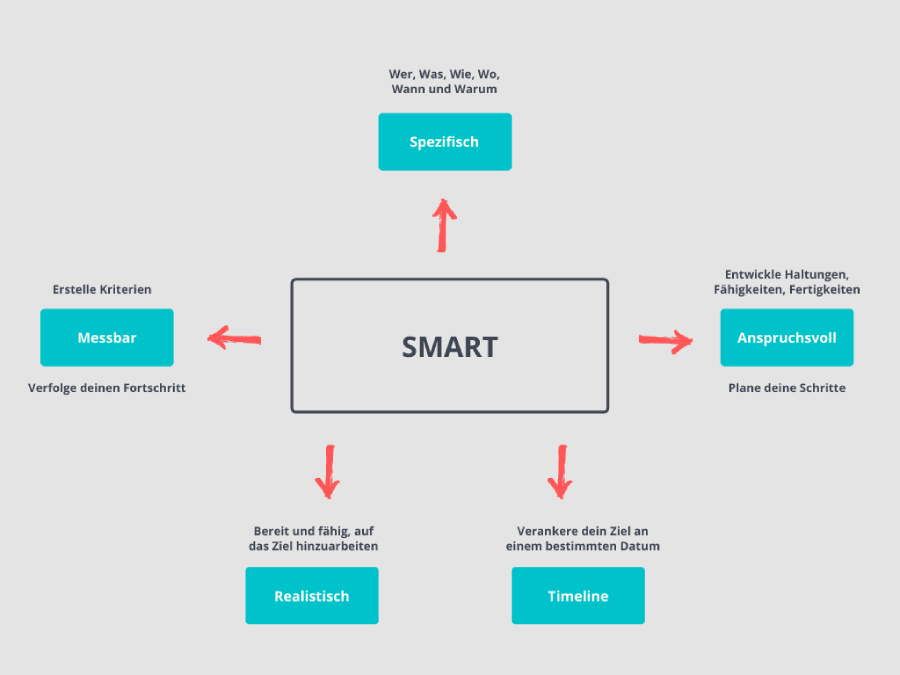
First and foremost, it is important to note that goals should always be SMART (Specific, Measurable, Achievable, Relevant, and Time-bound).
Main Goals:
- Increase visitors to the corporate website / Boost traffic
- Build trust
- Acquire customers
- Retain customers
- Generate leads
- Enhance product and brand awareness
- Establish expertise status
According to the SMART formula, the following goal would be suitable, for example:
In the next 6 months, we aim to generate 50% more leads through our new landing page.
What Is Content?
Content encompasses all components of an online presence that are actively used and perceived by its users, and not primarily part of the layout or design. This primarily includes texts, images or graphics, videos, and audio formats.
Text
Texts generally serve as the content foundation of a website. However, this does not mean that the respective content should be seen as mere standard elements. In fact, such content still forms the most important informational key for your customers.
If the target audience is provided with appropriate text information at each stage of the Customer Journey, these contents are frequently used, increasing the likelihood of converting many prospects into buyers. Nowadays, it is essential not to overly optimize textual content with keywords but rather focus on providing real added value, using natural language, and creating catchy and easily understandable structures. Originality, uniqueness, and personality are of particular relevance.
Image and Video
Videos and images are excellent for breaking up text blocks. Your customers are more likely to read through your text content completely when combined with such visual elements. Visual content has been increasingly preferred in recent years because this type of content is more quickly graspable.
Audio
Audio content provides auditory experiences for the audience. Essentially, the same principles apply here as with traditional content - your customers and their Customer Journey should be at the center. This can lead to even better usability. Audio content formats may include the auditory provision of blog texts, e-books in audiobook format, podcasts, audiograms, or voice assistants.
How Is a Content Marketing Strategy Developed?
A content strategy is part of the overall marketing plan and must be well-planned and purposeful. There are several essential aspects you should consider.
Firstly, it is important to decide for which audience the content will be created. Not all departments within a company interpret content marketing in the same way. The perspective varies depending on the objective. PR managers use content as part of public relations to build communities and reach in social networks. On the other hand, brand managers focus more on brand positioning. In online marketing, search engine optimization (SEO) plays a significant role.
Defining the target audience is closely related to the problems that the content should solve. What do you want to offer your customers? What interests them? What problems might they have? - All of these questions need to be answered. Therefore, it is crucial to know your target audience well. Additionally, you need to consider what makes your content unique. How does your content differentiate itself from the competition? This decision also involves choosing the formats you will focus on and the channels where you will publish your content.
Overall, when developing a content marketing strategy, both brand strengthening and sales should always be kept in mind. It is advisable to set a specific focus in advance.
5 Steps to Successful Content
There are various models that illustrate the implementation or development of content marketing. This model covers all five essential phases. The following explains how to understand them:
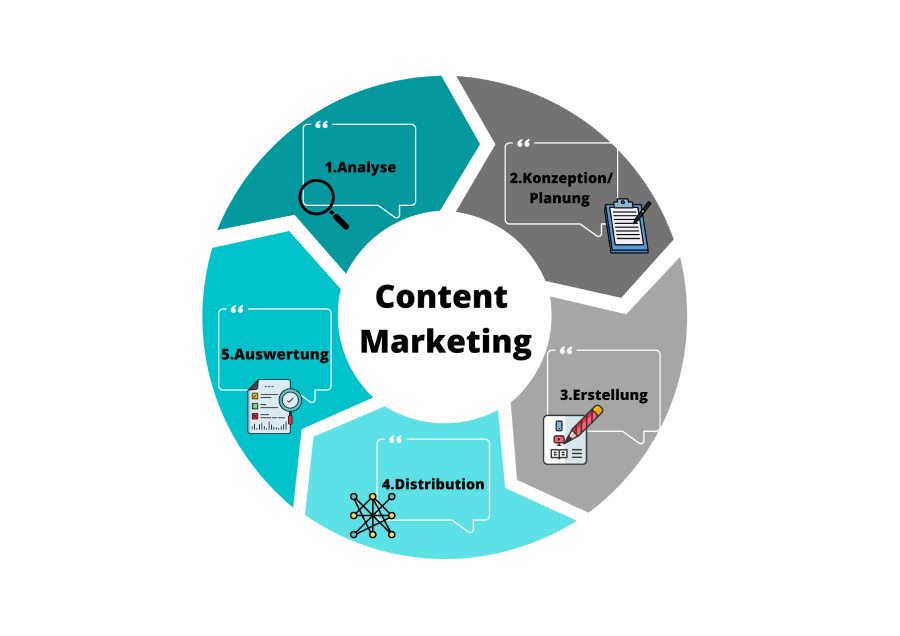
1. Analysis
In the first step, you need to gather all the essential information for planning and implementing the intended strategy. Define the goal and the corresponding target audience. What added value do you want to offer your customers, and what results do you expect? To answer these questions, you must identify relevant topics that align with both the target audience and the objectives. Additionally, this phase involves conducting a keyword analysis to define appropriate keywords for the chosen topics.
2. Concept/Planning
In the second step, decide which topics you want to cover, when, and in what format through which medium. What media and content formats are available to you? Are you focusing on push or pull measures? Is it about self-generated or paid content?
The planning of content activities is done along the Customer Journey, which represents the customer's path from the first interaction with a company's content to making a purchase. By using the Customer Journey, crucial decisions regarding the measures can be made.
Further planning of the content includes briefing, budgeting, and resource planning. These meticulous plans create the prerequisites for implementation.
3. Creation
At this stage, it's time to implement the pre-planned content. Before publication, it's essential to carefully review all the content. Grammar and spelling errors can have a negative impact on your image and create an unprofessional impression, potentially leading to customer loss.
4. Distribution
For the content to be discovered, it needs to be distributed. Without reach, even the best content is of no use. Optimal distribution is achieved through intensive search engine optimization and the use of social networks. The visibility obtained through SEO results in organic distribution by third parties, incurring no additional costs for you. It's like a sort of "self-runner."
5. Evaluation
Only by regularly evaluating the performance of your activities can you achieve long-term success. Various KPIs (Key Performance Indicators) are available for measurement. Depending on the objectives, some KPIs are more useful than others. Common KPIs in content marketing include page visitors, number of backlinks, generated leads, social shares, bounce rate, and time spent on the page.
Best Practices
1. Schwarzkopf
An excellent example of how to focus on user-relevant topics is provided by the hair cosmetics company Schwarzkopf. On their website, the emphasis is not on the products but on addressing the needs and questions of customers related to their respective products. It covers hair care, coloring, styling tips, and entertaining lifestyle topics, with the intention of making users feel that they are in competent hands and generating interest in their products.

Source: https://www.schwarzkopf.de/


This significant effort in content also benefits search engine optimization (SEO): Users search less for specific product names and more for terms like "hair coloring" or "hair trends 2022." Thanks to its content, Schwarzkopf has a good chance of being found through these or other hair-specific search queries on the web.
2. Dove
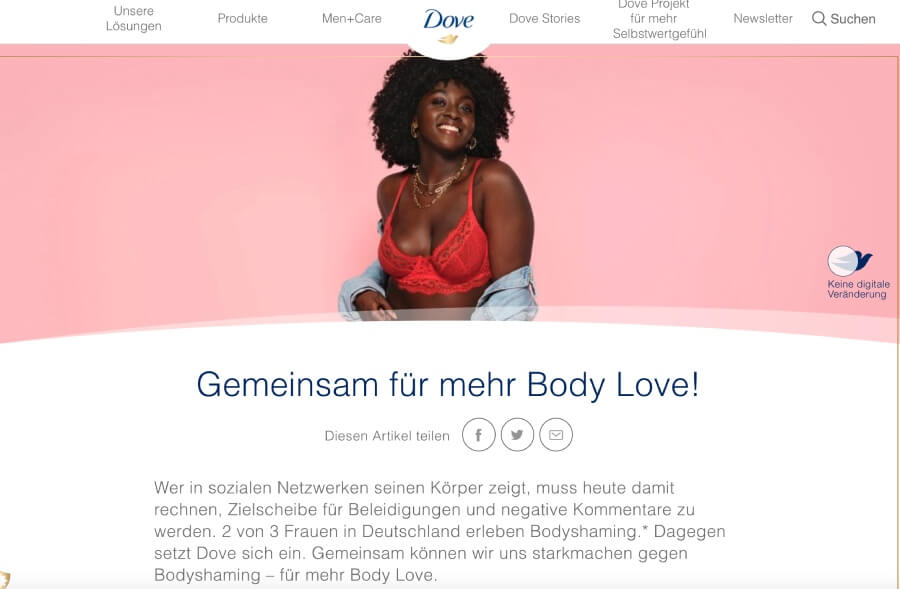
Another example comes from the body care company Dove. Here, the focus is less on the products and more on current topics like self-love and acceptance. These topics have been prevalent, especially on social media platforms like Instagram. With the statement "Gemeinsam für mehr Body Love" (Together for more body love), Dove connects with a large community (Body Positivity movement) and creates a positive image in this way.

Source: https://www.dove.com/
3. Red Bull
Red Bull is the ultimate content marketing virtuoso.
You may recall the TV commercials with the slogan "Red Bull verleiht Flügel" (Red Bull gives you wings). Over the years, Red Bull has truly grown its content wings. It now presents itself more like a large media and publishing company that happens to produce and distribute a drink. This includes a monthly magazine available in nine countries, a TV channel, entertaining web content in images, videos, and text, as well as the staging of thrilling stories.
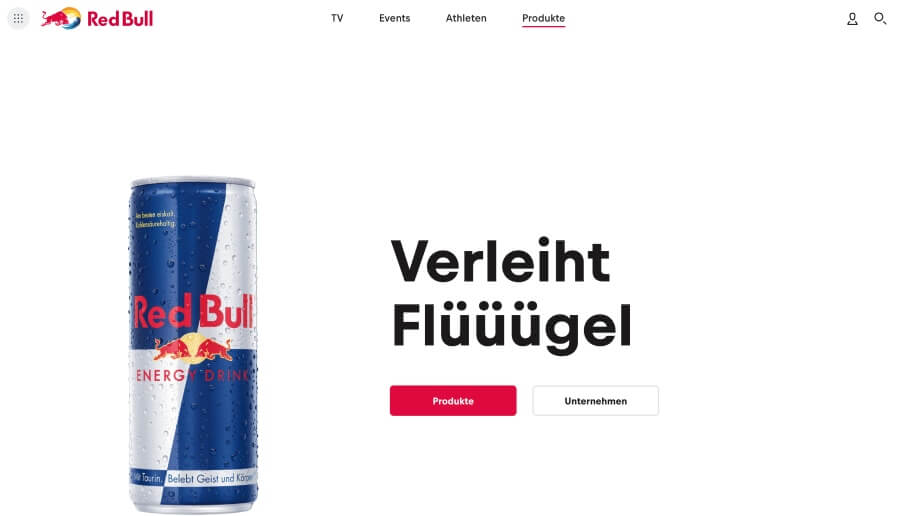

Source: https://www.redbull.com/
Lifestyle, adventure, adrenaline - these are the essential pillars on which Red Bull's content is built. The product rarely takes center stage.
8 Content Marketing Trends 2022

Source: GIPHY
1. Micro-Influencer
Influencer marketing is already widespread. Well-known social media personalities advertise products or services and make a living from it. Due to their high reputation, they have a significant impact on their followers. As a result, many brands and companies use influencers as a "mouthpiece."
However, with influencer marketing no longer being new and social media users becoming more sensitive to promotional content, large influencers have lost some of their credibility. The reason for this is the mass of promotional and video posts driven solely by "greed for money." Genuine opinions and authenticity have become rare in recent years.
Hence, one of the trends this year is Micro-Influencers. These influencers have considerably fewer followers, typically ranging from 1,000 to 10,000. The advantage is that they come across as much more authentic and credible since their reach is mainly composed of familiar acquaintances and friends.
2. Live-Videos
Video content has been very popular for years. However, this year, video content in the form of live videos on platforms like Instagram or Facebook has become even more crucial. This trend is likely to continue in the future as well. Even before the pandemic, live videos were prevalent as consumers prefer to get information quickly and in real-time. This allows for interaction through the integrated chat function. Moreover, live videos cannot be edited afterwards, which creates authenticity.
3. Podcasts
The podcast format gained popularity last year and continues to be a trend this year. Podcasts can be listened to in almost any situation, making them very practical. Many consumers listen to them while on the go, doing household chores, during workouts, etc.
With numerous podcasts available, standing out from the competition can be challenging. Nevertheless, businesses should capitalize on their potential to attract new customers and retain existing ones. Podcasts feel personal and authentic, which can foster trust among listeners.
4. Voice Apps
Voice assistants like those from Amazon or Google are becoming increasingly popular. They are already part of many people's daily lives, serving as helpful assistants in various tasks and interactions through spoken language.
Voice apps, known as well, have become a trend. These apps often use text-to-speech technology to convert texts into voices. As a business, you can use voice assistants to interact with users and associate your brand name with the assistant.
5. User Generated Content
User-generated content refers to content created by users themselves, which they then spread on various social media platforms for others to react and share. For businesses, this means less effort and fewer resources, as users create the content themselves. However, a suitable strategy is required to engage users accordingly.
Platforms like Instagram or TikTok have achieved this. Millions of people post various content daily and share it with the world. The platform you use will depend on your target audience, as not all platforms are equally suitable.
Encourage users to write blog posts or post about your company or products on social media. It's essential to moderate the action to maintain the quality of the content and support your brand. The downside is that it only works with an active community, and it is challenging to provide a classic briefing. Nevertheless, the task should be clear and easy for users to accomplish.
6. Communities
In almost every industry, there is a lot of competition. Standing out in such a crowded landscape can be particularly difficult. Therefore, it is helpful to serve a specific niche with less expected competition. This is where building a community comes into play. Communities are typically associated with social media platforms like Facebook or Instagram. They consist of a group of people who share common interests or passions.
Traditional content is no longer enough to generate new customers in the long term. Therefore, you should work on building your own communities, which serve both communication and relationship-building purposes. In this way, you can gain visibility without relying solely on Google.
7. Content Experience
The term "Content Experience" combines content marketing and customer experience, both of which aim to fulfill users' expectations, interests, and needs.
To keep users on your website, they need to feel comfortable. Numerous ads that obscure your content are not very useful. The page is quickly abandoned, and another is clicked instead. This negatively affects the company's success and Google ranking. Ensure that users can interact with your content easily and seamlessly, creating a positive experience.
8. Transparency
Consumers demand transparency. They want to know exactly what they are buying and not be constantly bombarded with unreliable advertisements. The authenticity of many brands is diminishing due to false self-representations, particularly for supposedly "green" brands that abuse their customers' trust. Therefore, you must place special emphasis on transparency. Honest communication with potential customers is more critical than ever, as concealing facts can lead to real scandals and upset customers.
Die größten Content Fehler

Quelle: GIPHY
Below is a list of some hints on the most common mistakes to avoid when dealing with content:
- Violation of usage and copyright rights
- Content that is too "salesy" or promotional
- Content not tailored to the needs of the target audience
- Cost-cutting in content creation at the expense of quality
- Wrong content format
- One-sided content format
- No early topic planning
- No long-term content strategy
- Quantity over quality of content
- Missing content strategy
SEO vs. Content Marketing
First of all: The term content marketing is not synonymous with search engine optimization!
However, these two terms are closely related:
Search engine optimization cannot work without high-quality content. Google has become so intelligent that it can distinguish between relevant and high-quality content from low-quality content. The former is rewarded with a high ranking in search results.
Conversely, it can be concluded that content marketing without search engine optimization also does not lead to successful results. What good is the best content if it cannot be found?
"SEO and content marketing are actually two personalities of the same person." - Neil Patel: Online Marketer
Fazit
Even in 2022, "Content is King."
The current trends are increasingly moving towards social media and should be authentic, honest, and relevant to the audience. Keyword: Quality over quantity!
Overall, content marketing remains a promising way to move away from intrusive advertising and instead create content with real added value. Whether in text, image, video, or audio form - everything is possible.
Are you looking for a suitable content creation tool? - We have the solution!
-> KingCon - The Ultimate Content Tool!

- Outperform the competition with the perfect SEO content!
- Efficient and cost-effective!
- Convenient - everything with just one tool!
- Easy to use
Interested? Then request a free demo now.