
Customer Journey:
Everything You Need to Know About the Customer Journey
Klaus Huber
23.03.2021
Undoubtedly, you have come across the term "Customer Journey" several times. But what exactly does this "customer's journey" mean?
This post explains what lies behind this concept. Moreover, it presents simple examples so that you will know exactly how to effectively utilize the Customer Journey in the future.
Customer Journey: Definition
The term Customer Journey translated means "customer's journey" and originates from marketing. It describes the journey of a customer from the initial contact or the first interaction up to making a purchase of a product, initiating contact, or utilizing a service.

This interaction is often referred to as a "touchpoint." Such touchpoints can include TV commercials, advertising posters, or testimonials on social media. The Customer Journey maps the journey across these touchpoints. Depending on the product and consumer, such a journey can take minutes, weeks, or even months. The same applies to touchpoints: their number can vary significantly. A Customer Journey is typically visualized in the form of a Customer Journey Map. The process of creating one will be explained further on, but it's essential to understand that each journey is unique.
Goals of the Customer Journey
One of the goals of the Customer Journey is to be able to use content more effectively in order to attract new customers. The behavior of customers plays a crucial role - the better you understand your customers, the clearer you can define your tasks in Content Marketing and address potential gaps. Furthermore, understanding the Customer Journey helps you identify weaknesses and improve the entire customer experience.
Another goal is to positively influence the customer and guide them in the right direction through the creation of a Customer Journey.
Minimizing wastage of touchpoints is also a goal. Such wastage can inflate the budget and, therefore, should be avoided. To ensure this, proper placement of touchpoints at the right time is essential.
The Touchpoints
As explained in the Definition section, touchpoints are the points of contact between a company and (potential) customers. Using these, the customer's journey up to the purchasing decision can be traced accurately. The list of possible touchpoints is long. All possible points of contact between a company and customers are considered touchpoints. These can be before, during, and after the purchasing process. In general, touchpoints can be divided into direct and indirect interactions: Direct touchpoints are those where companies interact directly with customers. Indirect touchpoints, on the other hand, involve third parties. These are contacts with the brand that are generated, for example, through friends and family, as companies cannot directly influence them.
In addition, the so-called multichannel touchpoints are significant in the context of the Customer Journey. In today's digital age, these digital and analog touchpoints quickly blend together, as the transitions are considered fluid: for example, you gather information about a specific product on the internet, visit the company's website, and find pricing information there. Subsequently, you visit a retail store and purchase the mentioned product there.
The 5 Phases of the Customer Journey
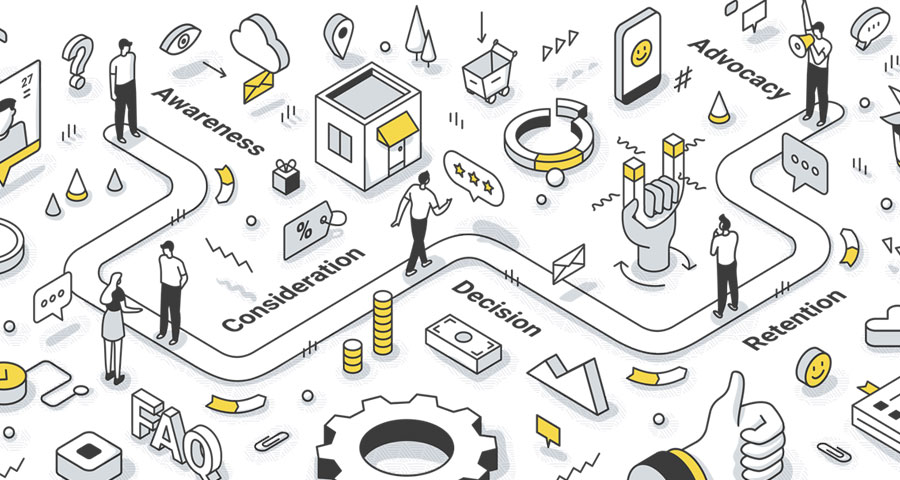
The Customer Journey is typically divided into five phases. These phases are based on the classic AIDA model, which describes the development from a person's initial interest to the purchase decision.
1. Awareness: Problem Solving
In this phase, companies should act as problem solvers. Customers develop problems and concerns that your company must solve. Since modern customers usually conduct internet research beforehand, it's essential that you have a presence on various platforms. This is where the first touchpoint begins. Therefore, the customer should be confronted with your problem-solving approach at this stage, leading to active perception. At this point, aspects like prices or further details are less critical as they are not decisive yet. Attracting content and engaging social media presence work better at the beginning.
2. Consideration: Narrowing the Choices
In the ideal case, the customer has stored your company in their memory, meaning you are in the running! Therefore, it's crucial at this stage to engage your customers and establish a long-term connection. The customer is now actively considering the product purchase or service. Therefore, interesting and relevant information from your side is needed.
3. Purchase: From Prospect to Buyer
In this critical purchasing phase, the prospect becomes a buyer, and you are close to achieving your goal, as you are in the final selection. You practically have the customer on the hook. Every step is now decisive. Discounts or social media incentives can help encourage the customer to take the final step and make the purchase.
4. Retention: Positive Service Experience
To ensure that it's not just a one-time purchase, you must ensure that the interaction with your customers remains active. Through touchpoints, customers should always be informed about new developments, enticing them to consider repeat purchases. These touchpoints could include social media posts, newsletters, or blog articles. Stay present even in this phase and make sure that your customers can reach you at any time and quickly in case of any issues - after-sales service is just as important as pre-sales!
5. Advocacy: Satisfied Customers as Advertising Potential
In the final phase, the goal is to generate new customers through existing ones. You may spend a lot on advertising, but if your customers are dissatisfied, it can quickly become public knowledge. Particularly in today's interconnected world, positive and negative experiences spread rapidly. That's why satisfied customers are essential. Personal recommendations from your customers are invaluable advertising potential. To further boost this, you can offer incentives, such as discounts, when customers refer new customers. This benefits the existing customers, the new customers, and, of course, you.
Evaluating the Customer Journey
The goal of evaluating the Customer Journey is to gain insights into consumer behavior.
A Customer Journey should be comprehensively captured and evaluated. To tailor online advertising efforts directly to potential customers, it is essential to estimate how individual advertising measures relate to the progress of the purchase decision process at different stages of the Customer Journey. However, this can only be achieved if the sequence of individual touchpoints can be tracked.
The data needed for this can be obtained through web analytics tools such as Google Analytics. Using this program, you can track how often a user comes into contact with specific advertising measures. Additionally, you can trace the sequence of touchpoints and identify the devices the user accessed the site with.
If you prefer not to conduct your own analysis, you can access data on purchase decision processes. The blog Think with Google provides this data for free. Over 36,000 users have made their data available for evaluation. This way, you can gather relevant information for your industry to boost your online business and create a perfect shopping experience for your customers.
Example of a Digitalized Customer Journey
Let's consider an example of a company that has launched a new tablet on the market, claiming to offer unbeatable value for money and innovative features: "Quality at an affordable price."
To ensure that potential customers become aware of this product, the landing page is optimized using SEO techniques. Additionally, the company promotes the innovative tablet through social media networks. In the first phase, a potential customer becomes aware of the company due to its extensive marketing activities and remembers it when considering a purchase.
In the second phase, the customer engages more closely with the product. They visit the company's landing page, which serves as a central touchpoint. Here, the customer learns about product features, prices, available stores, etc. Product photos and videos can help the customer form a better impression of the product.
Only after being convinced by the company's online presence will the customer consider making a purchase. However, it's essential to remember that the customer is likely to also explore competitors' offerings and review platforms.
Since customers may bounce back and forth in their decision-making process, it is vital to keep them engaged through various touchpoints and interesting information.

In the third phase, the customer is ready to make the purchase. Ideally, they have not found anything similar from competitors and are only interested in the company's product. Offering the customer a discount through newsletters or social media at this stage can highly likely lead to a purchase.
In phases four and five, the focus is on creating a positive service experience to retain the customer in the long term. For example, if there are any issues with the tablet, the support team must quickly resolve them. This ultimately leads to positive experiences being shared with friends and family. The Customer Journey should not end after a one-time purchase; instead, it aims to retain existing customers and attract new ones.
Differences Between B2B and B2C
There is a notable difference between planning the Customer Journey for end consumers (B2C) and for business clients (B2B). While the offerings for end consumers are relatively straightforward, meeting the requirements of business clients is not as easy. The reason for this lies in the different decision-making processes.
B2C customers typically make quick decisions when it comes to product purchases. In most cases, they decide on their own, and only a few individuals, such as family or friends, might be consulted. With the ability to order almost any product online, the purchase process often takes only a few hours. However, for more expensive purchases like a new car, the research process to the final purchase might take several weeks or months.
In the B2B sector, decision-making processes take longer. Especially for expensive capital goods, thorough consideration is necessary to determine whether a purchase is feasible. Additionally, many people are involved in the decision-making process. Due to the higher complexity, discussions on making the right choice can last for several months. As a result, planning and producing the right content for B2B Customer Journeys become significantly more challenging.
The Customer Journey Map
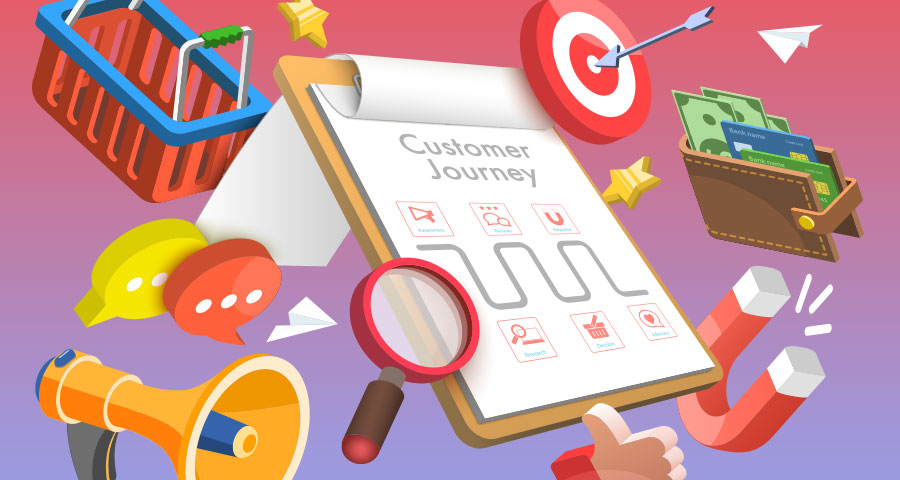
The Customer Journey Map is a tool used to depict the entire Customer Journey of a customer in detail. The map is typically presented visually, making it not only easy to comprehend the customer journey but also easier to describe. Importantly, there is no "right" or "wrong" way to create a Customer Journey Map.
The main goal is to comprehensively represent all touchpoints with the company. It is also essential to understand the customer's feelings and motivations. Moreover, identifying positive moments and addressing negative ones is crucial. All these insights should be considered when designing any products and services.
Creating the Customer Journey Map in 5 Steps
Step 1: Create Buyer Personas
To tailor your marketing efforts effectively to your customers, you need to analyze and understand their behavior. Therefore, in the first step, it is essential to collect internal and external data from existing and potential customers. You can learn more about this in the blog post about Buyer Personas.
Once you have evaluated the data, you can start creating your Buyer Persona. Capture as many important data points as possible to support assumptions about your persona.
Step 2: Define Phases and Touchpoints
In the second step, define the individual phases and touchpoints of the purchase process. You can use the above-mentioned phases and determine the touchpoints, building them along the five phases. The number of touchpoints you need depends on the purpose you intend to achieve with the Customer Journey Map.
- Awareness
- Consideration
- Purchase
- Retention
- Advocacy
Step 3: Identify Key Channels
In the third step, identify the communication channels your customers use. These channels can be both online and offline. Ensure that you consider all relevant channels for your Buyer Persona. In the example of the digitalized Customer Journey, these could include SEO, the landing page, and social media networks. Based on the identified touchpoints, you can now implement and improve processes.
Step 4: Determine Emotions
Emotions and feelings of the Buyer Persona have a significant impact on the purchase process. Therefore, it is essential to recognize and consider them.
Goals, desires, and challenges can vary greatly depending on the touchpoint. To be prepared and able to react optimally, you must know and understand the behavior of your Buyer Persona precisely. Also, find out what your persona needs at each point and through which channel to feel satisfied. The intensity of emotions at different touchpoints also plays a significant role.
Step 5: Analyze and Continuously Adapt
Once all relevant information is gathered, channels and touchpoints are identified, and emotions are considered, you can start visualizing the map. However, the success of the measures can only be determined in practice. It is crucial to remember that the Customer Journey Map is just a model. Therefore, you must continuously analyze and adapt your measures. Otherwise, success will not be sustainable. Continuous adjustments are necessary to succeed in the market and make customers happy. If dissatisfaction arises suddenly, these issues must be resolved as quickly as possible.
Weaknesses of the Customer Journey Model

Among all the positive aspects of the Customer Journey, there are still some weaknesses: Not all touchpoints within the Customer Journey Map can be accurately captured. This is because, for example, recommendations from friends or perceived advertisements cannot be easily traced. Moreover, conducting customer surveys may not be feasible at every location, making it even more challenging to analyze offline touchpoints.
Only through market research can this problem be addressed. In the field of online marketing, however, things are different. Specific tracking tools allow touchpoints to be tracked and evaluated relatively easily. But here, too, there is a problem - data privacy. If a user deletes their cookies or uses a tool that prevents tracking, the customer journey cannot be accurately reconstructed. Additionally, merging different data is only allowed under certain conditions.
Conclusion
The Customer Journey is a constantly evolving process. Therefore, you must be able to react very flexibly and in real-time. It is essential to know which phase of the decision-making process your customer is currently in, to be able to address their needs accordingly. Your customer must be picked up at the right time and at the right touchpoint. Only then can you influence their journey in a way that leads to the desired conversion.