Local SEO 2022:
Reach Local Top Ranking with these Tips!

Klaus Huber
June 11, 2021
If you run a local business or offer local services, then Local SEO is your ultimate weapon for achieving a top-ranking on Google. We provide you with all the information you need to successfully implement local search engine optimization on your website.
What is Local SEO?
Local SEO is a part of search engine optimization aimed at ranking as high as possible in the search results for a specific area.

Today, before visiting a store, people usually gather information on the internet. Local search engine optimization is crucial for all businesses and companies with a physical location (e.g., hairdressers, doctors) or those offering services in a specific region.
Local Snack Pack
The results of local searches conveniently appear above the organic listings in the so-called Local Snack Pack. This includes the top three companies near the searcher.
Google is remarkably precise and provides excellent results even for concise queries. For example, if you enter "tax consultant Munich" in the search bar, Google immediately recognizes it as a local search and delivers relevant information:
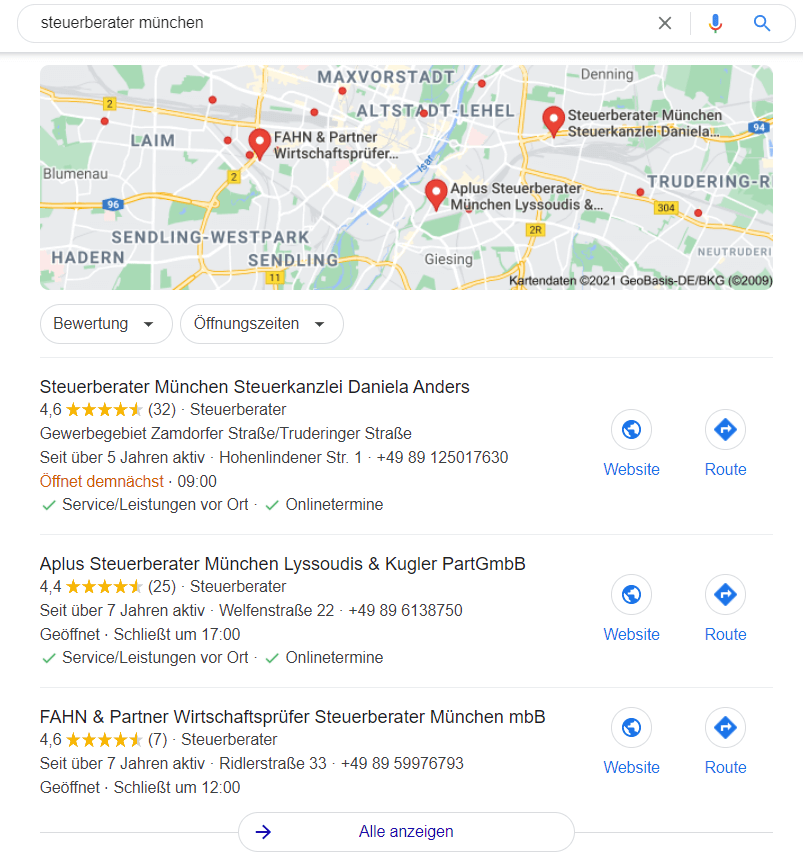
In this section, you can only rank if you have an address in the respective location. In the organic results below, your business may also appear if you don't have a physical location in the city.
You'll find out how to perfectly optimize your website for the Local Pack in our practical section below.
Why is Local SEO important?
Local SEO can significantly increase visibility and, therefore, attract more foot traffic for small and medium-sized businesses (SMBs).
Because: 76% of users who initiate a local search visit the location within a day, and a whole 28% of them make a purchase or use a service there (Think with Google).
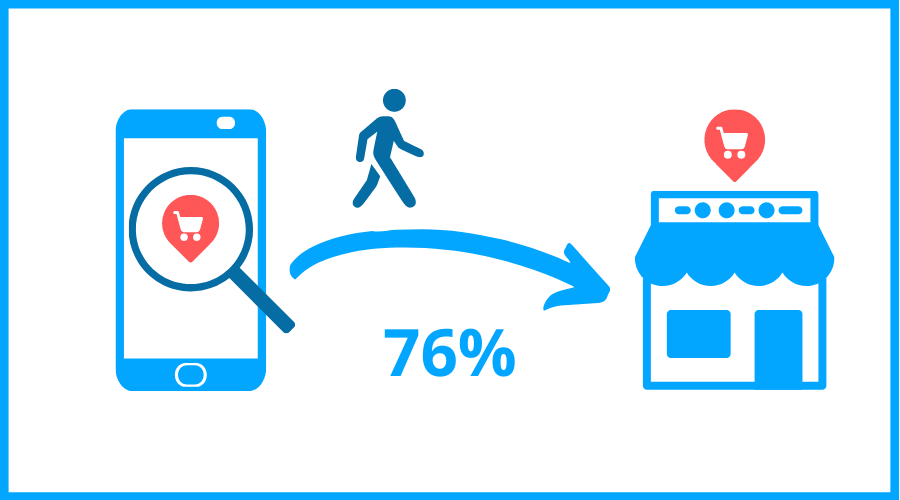
Meaning: Behind a local search query often lies the desire to make a purchase.
Enormous potential that you can also leverage for your business and thus increase revenue.
Local SEO - And How It Works!
Do you want your business to be in the pole position on Google? Great, because we have compiled the most important Local SEO factors that will help your website achieve a top placement.
Local SEO Content
Local content is very similar to regular SEO content but differs in that it has a strong regional focus.
This includes, among others:
- Photos of the company's premises
- Directions
- Information about opening hours
- Presentation of projects (e.g., renovations or grand openings).
- Trust factors such as certificates or pictures of on-site contact persons
With Local SEO, it's also about providing users with high-quality content that perfectly matches their search intent. Ideally, the content should also answer the question of why the product or service is relevant to the specific location.
The website must function flawlessly from a technical standpoint, and the relevant keywords should be placed in key locations on the website:
- in title and meta-description
- in the headings
- in the first 100 words
- in the alt tag of images
- in the anchor texts of links
TIP: Want to refresh your SEO knowledge? You can find everything you need to know about search engine optimization in our comprehensive SEO guide.
Keyword Research
Local searches are typically performed with the format "business + location" or "service + location," e.g., "dog groomer Berlin." This way, you can already define some initial keywords for your content.
However, don't just include the name and designation of your business in your keyword research, but also the individual services you offer.
For example, if you run an auto repair shop in Hamburg, you can also rank for keywords like "change tires Hamburg."
TIP: Create a list of all the services your company offers and connect them with the location you want to rank for.
It's also worth including the entire catchment area of your business in the keyword collection. For example, if you operate a dog grooming salon in Harburg (a district in Hamburg), you can use both the keyword "dog groomer Harburg" and the keyword "dog groomer Hamburg."
Let's take a look at the example:

The search volume for "dog groomer Harburg" is relatively low with a value of 100...
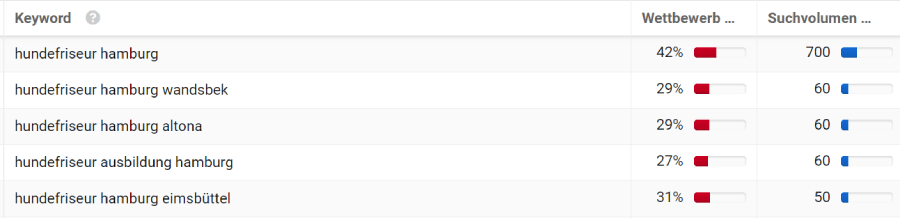
... whereas the keyword "dog groomer Hamburg" looks much better.
TIP: Of course, you always need to individually assess whether you have a chance to rank for the respective keyword.
In the past, local search queries often included the addition "near me" ("hairdresser near me"). Nowadays, this is no longer necessary, as Google automatically includes the user's location data and can accurately determine whether a query is local or not.
Landing Pages for Multiple Locations
If your company has multiple locations or branches in different places, you will need several landing pages. Ideally, you should have a main homepage that links to the individual local pages.
Ensure that the pages contain location data in important places such as the meta description and headings. Also, include important elements like location maps, an introduction to the on-site team, and contact information.
Structured Data for Local SEO
Structured data are specifically marked information that helps search engines better interpret the content of a webpage. These data are not visible to users as they are included in the HTML code of the webpage.
With Schema.org, a standardized format for structured data, you can add information such as opening hours, phone number, business category, etc., and gain an advantage in ranking.
TIP: You should mark as much information as possible. The Google Markup Helper assists you in creating structured data.
Mobile Optimization
Many users conduct local searches using a mobile device, often because they are on the go and need quick information about a specific business or location.
Mobile optimization is, therefore, a crucial ranking factor for Local SEO. In this process, website content is programmed using responsive design so that it adapts to the respective screen size.
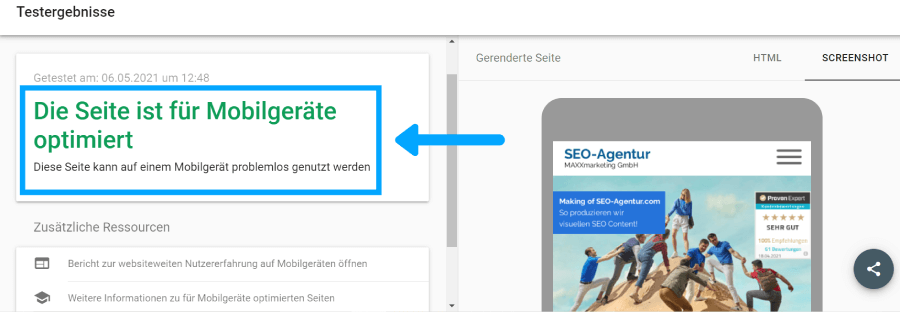
TIP: Use the Google Mobile-Friendly Test Tool to see how well your website is optimized for display on mobile devices.
NAP and Local Citations
The abbreviation NAP stands for "Name," "Address," and "Phone". It refers to the company name, exact address, and phone number.
Here, you should always use the same format, both on your website and in various business directories. If you use different formats, search engines may not be able to associate the data correctly.
TIP: It's best to record the name, address, and phone number consistently in an Excel spreadsheet. That way, whenever you need to add your listing to a new directory, you can refer to it easily.
References to the NAP data and mentions of the company are called local citations. These do not require links; it is sufficient for the company to be mentioned in the body text of a webpage.
If these references remain the same for an extended period, it signals to Google that the data is accurate. Therefore, it is beneficial to ensure your business is listed in local industry and business directories (e.g., Yellow Pages or Yelp).
Google My Business Listing
The entry in Google My Business is an essential component of Local SEO as companies with such a listing are clearly preferred by Google. With GMB, you can manage how your business information should be displayed in search results.
How to create a GMB listing:
First, go to the Google My Business homepage and sign in with your Google account or create a new one.
TIP: It's possible that a listing for your company has already been created. In this case, you can claim the listing (Select the business and click "Request Access").
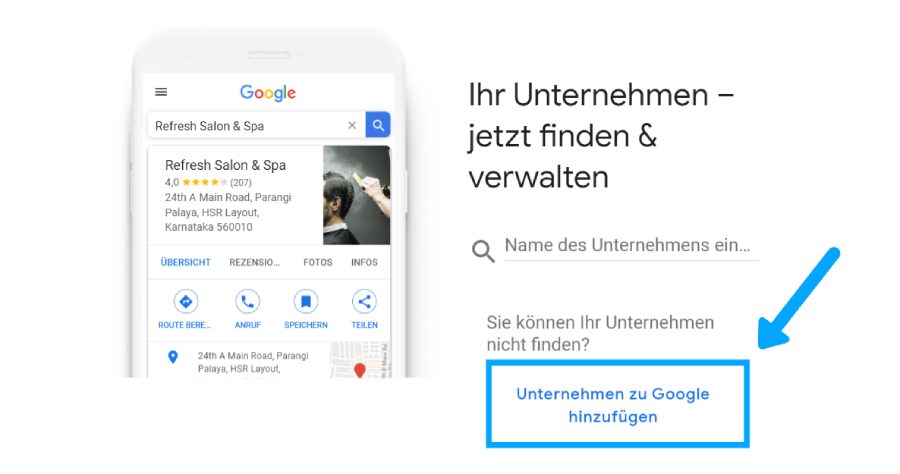
If there is no existing entry, choose "Add Business to Google," enter the company name using the official spelling, and add the address.
Next, you can indicate the precise location with the Google Pin (Google usually displays this accurately, but you can adjust it if needed).
Then, you need to add the category of the business, phone number, and website URL.
Finally, select a verification option to verify your data.
TIP: If you work from home, choose your home address. This can later be hidden and will only be visible to Google.
How to Optimize Your Listing Properly!
By entering the business information, you have already laid the foundation for Local SEO. However, your GMB listing can be further optimized, and you should do so because the more information your profile provides, the more attractive it is to potential customers and the search engine.
- Enter your opening hours and keep them up to date, including on holidays.
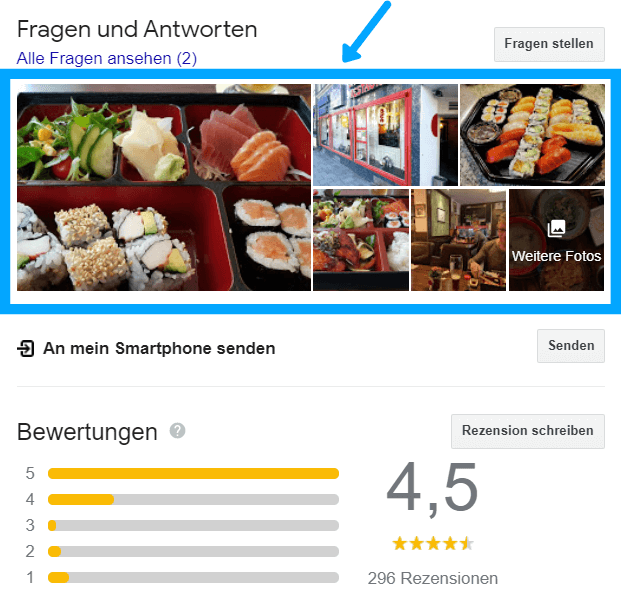
- Add images or videos to your listing. These can include images of your business premises or, for example, for restaurants, photos of selected dishes.
- Create a company description. Be informative and avoid being too promotional; neutrally describe your company's services.
- Add the website to which you want to link.
- Depending on the services you offer, you can set up appointment scheduling directly through Google.
How your GMB listing is ranked depends on three factors:
- Relevance: The listing must be relevant to the customer's needs and tailored to their specific search intent. Specifics like "... open on Sundays" may seem banal, but regularly updating such details gives your listing an edge.
- Prominence: Prominence is achieved through activities happening around the listing, such as regional backlinks (e.g., from local press), regular updates, events, customer reviews, etc. This factor also indicates how well the company fits into its respective category.
- Distance: This factor depends solely on whether the user is near the business location or not. As a website owner, you have no control over this.
Customer Reviews / Reputation Management
Positive customer reviews are the best advertising for your business. According to the Local Consumer Review Survey (2020), 94% of consumers are more likely to use a company's services if the reviews are positive.
You should definitely keep an eye on Google reviews and, logically, respond appropriately to them.
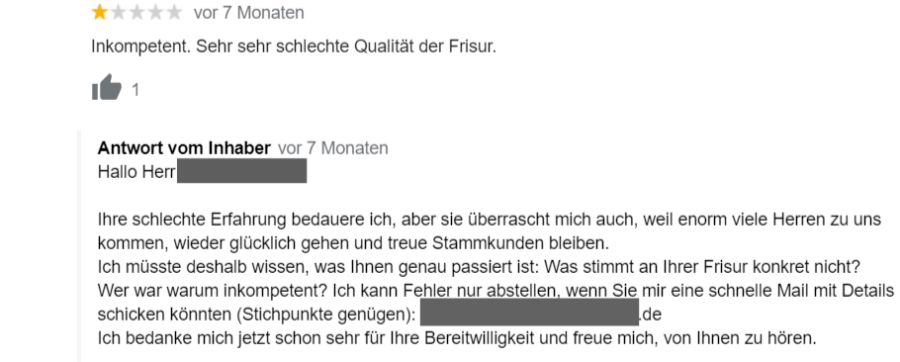
Even if you receive negative reviews, respond to them professionally to show that you are receptive to feedback and care about your customers' concerns. For example, thank them for their feedback and ask for suggestions for improvement.
Here's an example of a response from the owner of a hair salon:
TIP: Don't panic about negative reviews! A few negative or average reviews contribute to presenting a realistic picture of your company. They make your business appear more authentic.
Wondering how to get reviews? Reviews usually come naturally, but you can accelerate the process by actively asking your customers for reviews. You can do this via email or through social media channels.
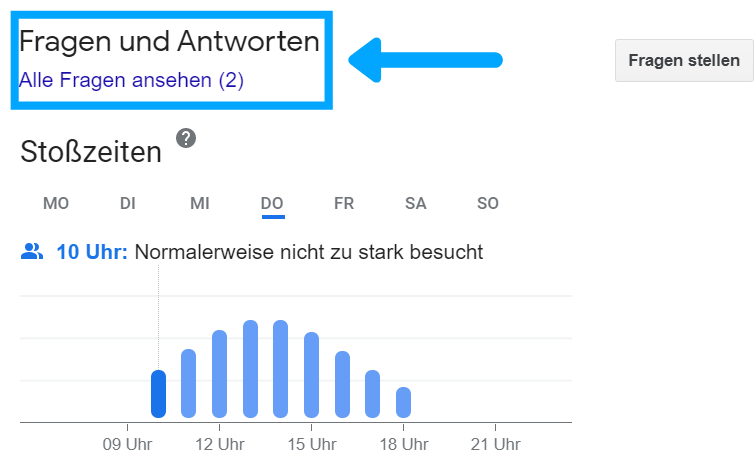
Also, keep an eye on the Questions & Answers feature on Google My Business. There, you can gain insights into your customers' wishes and concerns. These questions may provide topics that you can incorporate into your content.
TIP: Does the company have social media accounts? Then you should definitely maintain them and regularly engage with your customers there.
Overview: The Most Important Local Ranking Factors
Finally, we have the most important Google ranking factors for local SEO. This is a summary from a 2018 MOZ study where industry experts were asked about the most influential local SEO criteria.
The results are as follows:
Factors for Organic Results
- Backlink signals (authority, anchor text, etc.)
- Website signals (domain authority, keyword placements, etc.)
- User signals (click-through rate, dwell time, etc.)
- Signals from Google My Business (business category, proximity of the user to the location, etc.)
- Citation signals (consistent NAP data, frequency of business mentions, etc.)
- Personalization, including NAP data
- Reviews (quantity, frequency, diversity, etc.)
- Social media signals (posts on Facebook, Twitter, etc.)
Factors for the Local Pack
- Signals from Google My Business (business category, proximity of the user to the location, etc.)
- Backlink signals (authority, anchor text, etc.)
- Reviews (quantity, frequency, diversity, etc.)
- Website signals (domain authority, keyword placements, etc.)
- Citation signals (consistent NAP data, frequency of business mentions, etc.)
- User signals (click-through rate, dwell time, etc.)
- Personalization, including NAP data
- Social media signals (posts on Facebook, Twitter, etc.)
These factors should be considered only as general guidelines. The Google algorithm is constantly changing, so these criteria may have varying degrees of influence. If you want to learn more, you can find all the information in our article on the 50 most important Google ranking factors.
Conclusion
If you operate a local business or offer services, then Local SEO provides you with the attention you need to maximize your revenue.
Here are the key points summarized:
- Create a Google My Business listing and regularly maintain it.
- Ensure a consistent format for your NAP data (Name, Address, Phone).
- Establish a local relevance with your content.
- Implement reputable reputation management and build trust through quality seals, certificates, etc.
In general, everything that applies to conventional SEO also applies to Local SEO. That means providing high-quality content and value to your users. Make sure your users get the information they need.
Stay up to date with us: Our articles are continuously expanded and regularly updated.