
SEO 2022:
The Ultimate Guide for Beginners!

Klaus Huber
April 21, 2021
Nowadays, we don't take a step without first searching for information on the Internet. We look for products, guides, or the next travel destination. Search engines like Google have become so advanced that they can deliver almost perfect results for every search query.
That's exactly why every website owner depends on Search Engine Optimization (SEO). It is the key to achieving the highest visibility for Internet users and generating more revenue.
But what is Search Engine Optimization (SEO) exactly? And how can I use it to benefit my business? We have the answers to these questions in the form of an ultimate guide for you.

What is SEO?
The abbreviation SEO stands for Search Engine Optimization. The goal of SEO is to bring a website as high as possible in the organic search results (SERP = Search Engine Result Page) through content and technical measures.
Organic means that the placement in the search results is not paid. Depending on the search query, the Google results may display paid ads first, known as Google Ads. Only below them are the unpaid results.
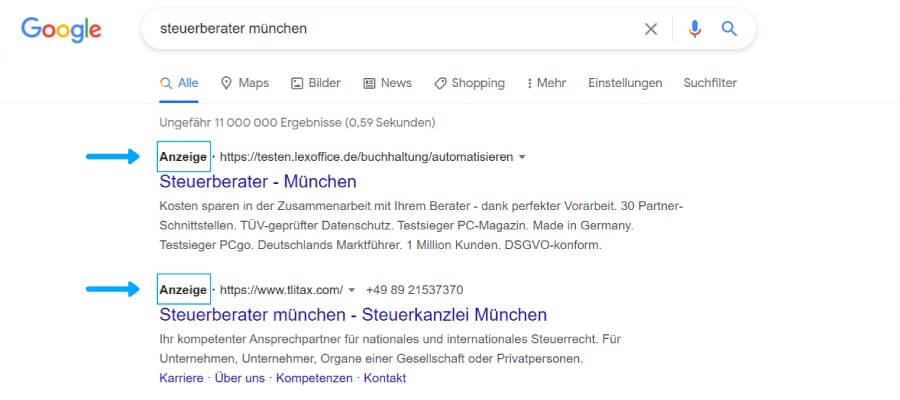
In theory, SEO can also be used for other search engines like Yahoo or Bing. However, practically all optimizers focus on Google as this search engine dominates the market in Germany with over 80 percent market share for desktop searches and over 90 percent for mobile searches (according to Statista in 2021).
How Does SEO Work?
Keywords, or key terms for a specific topic, are extremely relevant for search engine optimization. Users enter these keywords into the search bar to start a search. Google then tries to display the relevant results for the respective keyword.
SEO, however, consists of a whole set of different measures. These are divided into OnPage and OffPage optimization.
- OnPage SEO encompasses all the measures that can be directly implemented on the website to improve its ranking.
- OffPage SEO refers to all optimization efforts outside the website. This includes primarily building backlinks, which are links from other websites that point to your site.
While OffPage optimization mainly focuses on the reputation of the website and creating a credible link profile, OnPage optimization can be further divided into content-related factors (content and design) and technical factors.
Basic SEO Measures
What does Google pay particular attention to? We have summarized the most important components for a good search engine ranking.
High-Quality Content
In this context, "high-quality" means that the content is relevant to the users. Users want to find all the information related to their search query quickly and in understandable language. Avoid outdated information or thin content (lots of text with little information).
For your content to be considered high-quality, it should not only be understandable but also factually correct and up-to-date. Only then can it provide maximum value to internet users.
Content Design
If your content is meant to convince, you should also visually format it and ensure an enjoyable readability of the text. Graphical elements such as images and videos, short paragraphs, bold highlights, and bullet points create a varied text layout and help your users navigate through the content.
Technical Aspects
A well-functioning and cleanly programmed website is another step towards achieving a top-ranking. Google equates flawless technology with quality. Your online presence should meet the following technical prerequisites:
- Fast loading times
- SSL certificate
- Mobile optimization / Responsive design
- No HTML errors
Structured Data
Technical aspects also include the so-called structured data. These are specific pieces of information that are specially marked for the search engine.
For example, in recipes, data such as the recipe author, ingredient list, and calorie count can be precisely marked. The web crawlers at Google can then better interpret and visually present the content. The more the search engine knows about the website, the easier it is to evaluate the content.
The standardized format Schema.org offers markups that can be added to the source code of an HTML document to include this additional information.
Structured data enhances ordinary search results (snippets) to so-called rich snippets. These contain additional information such as price, rating, author, etc., and are clicked more often.
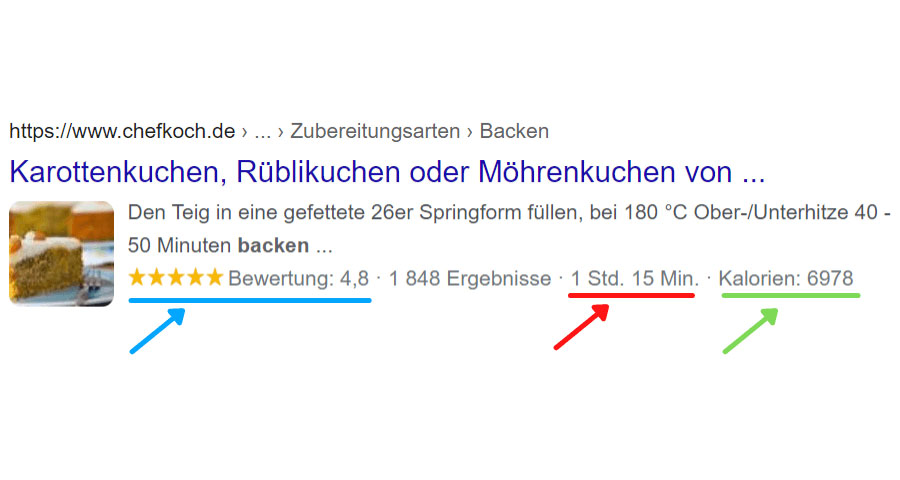
Here is a rich snippet for the keyword "baking carrot cake." The snippet contains additional information about the recipe's rating, preparation time, and calories.
TIP: To check if you have correctly implemented your structured data, you can use the Google Structured Data Testing Tool.
Core Web Vitals
From May 2021, the so-called Core Web Vitals play an important role in user experience and, consequently, Google ranking. It mainly focuses on loading times and performance of the website:
- Largest Contentful Paint: Measures the time it takes for the main content of the page to load.
- First Input Delay: The time it takes for the website to respond to the first user interaction.
- Cumulative Layout Shift: This value indicates how stable the page's layout is and whether individual elements shift during loading.
You can check the Core Web Vitals in the Google Search Console.
Authority: EAT and YMYL
Since 2018, the so-called E-A-T has been an important quality standard for Google. The acronym stands for Expertise, Authority, and Trustworthiness. Therefore, Google prefers websites that demonstrate these qualities.
This concept applies to all internet platforms, but particularly for YMYL content. YMYL stands for "Your Money, Your Life" and refers to content that could impact a person's health or financial situation.
YMYL also includes pages providing information about specific groups of people or featuring risky tutorials (e.g., electrical installations with potential property damage). When writing about the functioning of a certain medication on your website, for example, errors are not allowed. This is because it concerns a person's physical well-being and quality of life. Google, therefore, pays greater attention to ensuring accuracy in such content.
How to Achieve E-A-T?
You can achieve this through high-quality and relevant backlinks that act as recommendations for your site. For instance, if you write about medical topics and several doctors link to your website, Google will consider your content as credible.
You can obtain reputable backlinks mainly through high-quality content that you actively promote (e.g., on social media). Contributing guest articles to other thematically related websites can also boost your link profile.
TIP: While it may be tempting to acquire numerous links quickly, many resort to buying links. However, this method is likely to result in penalties from Google. Therefore, avoid such shortcuts.
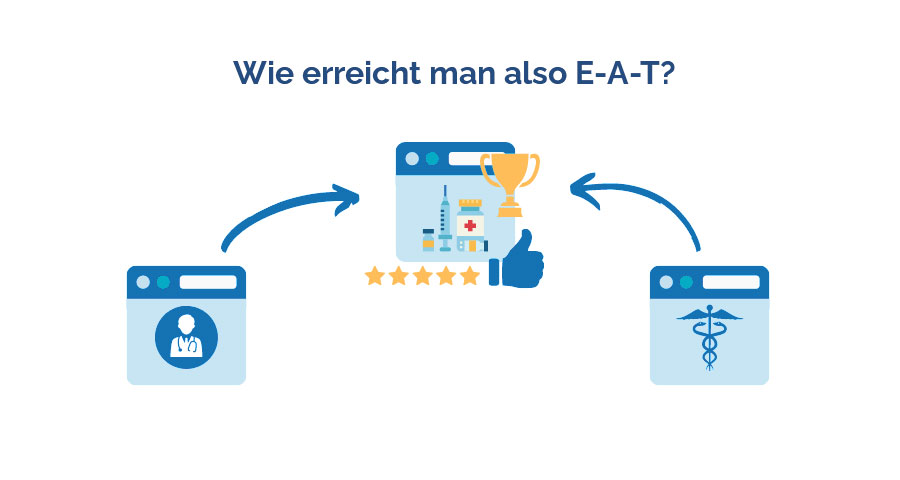
Equally important are reliable sources and the expert status of the author. The contributors should not be unqualified amateurs but rather expert journalists with meaningful references and awards.
If you want to rank for a YMYL topic, then you should invest time and resources in research and content creation.
Who needs SEO and what does it bring?
Search Engine Optimization is the most efficient strategy for ensuring long-term success and revenue growth. While it may require significant time and effort initially, it eventually becomes a profitable self-sustaining process.
Why? Because Google loves high-quality SEO content and rewards it with consistently good rankings, attracting more potential customers in the process.
Anyone who operates a website can benefit from search engine optimization. This includes primarily online shops, service providers, companies with an online presence, and bloggers. However, local providers and businesses can also be found more easily and increase their profits through SEO measures.

With the right content, you can also engage your customers in various stages of the so-called Customer Journey.
The Customer Journey is a term from marketing that refers to the metaphorical "journey" of a person from prospect to customer. Typically, this customer journey looks like this:
Through search engine optimization, you can capture the attention of potential customers during the decision-making phase of their journey. Often, users have not yet decided on a specific product or brand when they make a search query on Google. This is where you need to catch the potential customer's interest.
How do search engines work?
Search engines like Google scan all websites, index (store) them, and make them available to internet users. The scanning process, where the so-called Google bots jump from one link to another, is also known as crawling.
This crawling process takes place at regular intervals for already registered websites to detect any changes. The index is not static, as new websites are constantly added, and those that violate the guidelines are removed.
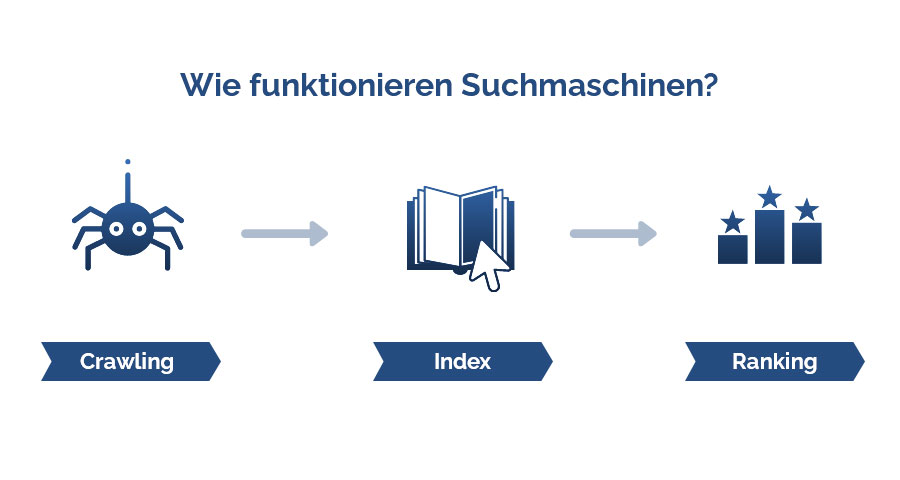
Depending on the search query and the user's location, the pages are ranked differently on the SERP (Search Engine Result Page).
There are hundreds of so-called ranking factors that determine how websites are arranged in the search results. Some of these factors are known, but many are kept secret by Google to prevent manipulation.
TIP: In our article about Google ranking factors, we have summarized the 50 most important ranking criteria for you.
Of particular importance are the so-called user signals. Every time a user interacts with a website (e.g., makes a purchase or spends a long time on the site), Google can interpret and evaluate it as user satisfaction. If a page receives many such positive user signals, it will positively impact its ranking.
Even though only the first maximum of four websites in the SERPs are paid advertisements, Google still aims to offer the best possible results to its users. Only if users are completely satisfied with the results, will they continue to use the search engine and not switch to the competition.
Knowledge Graph and Entities
For pure fact-based searches, Google retrieves results from its own database rather than just displaying web pages that provide an answer. This vast network of data is known as the Knowledge Graph.
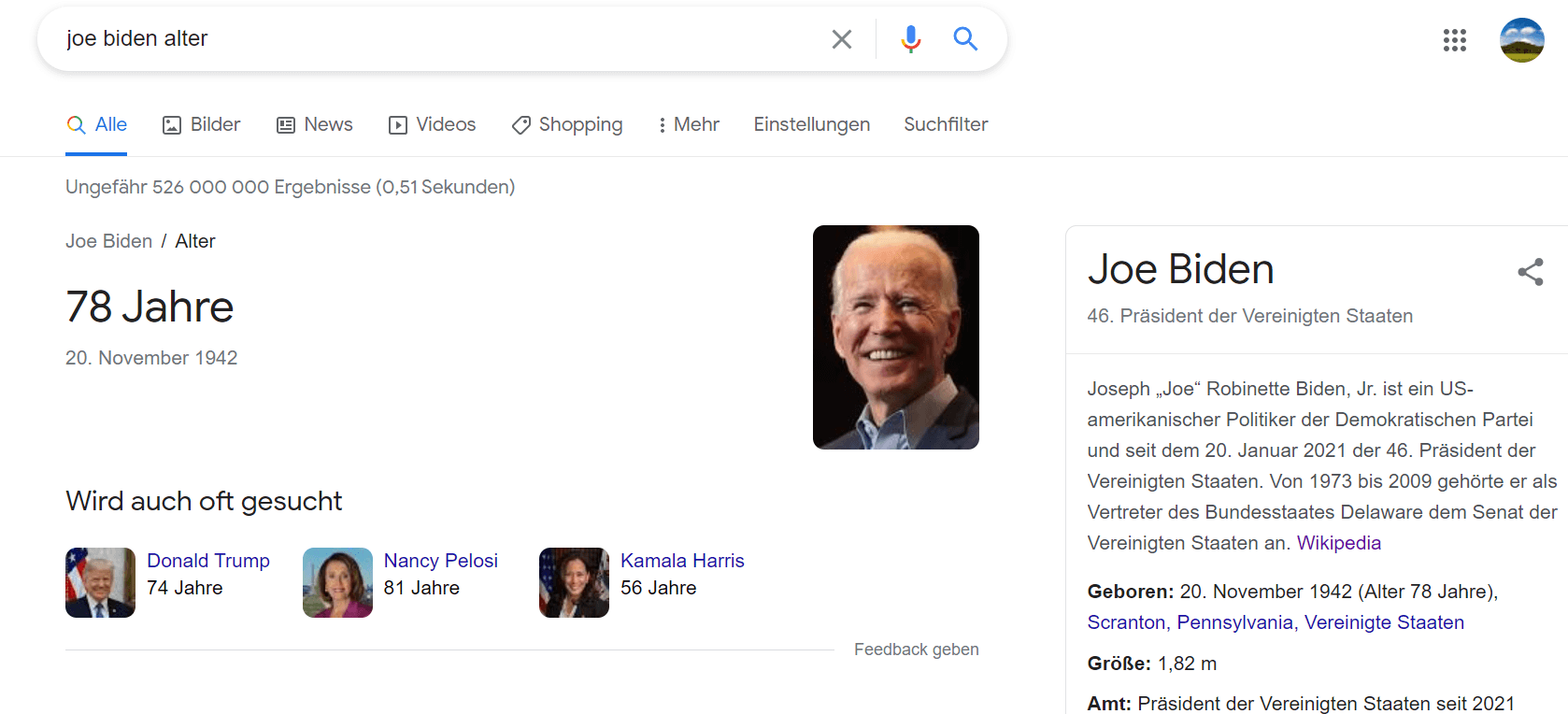
Example: When searching for "joe biden age," Google responds with specific facts from this database:
This large data network consists of individual entries called entities.
Entities can be, for example, people, places, or specific things. The Knowledge Graph establishes relationships (relations) between entities and contextualizes them.
For the entity "Joe Biden," there are various relations, such as:
- President of the USA
- is a man
- born on November 20, 1942
- height is 1.82m
Therefore, Google can recognize that the entities "Joe Biden" and "President of the USA" currently refer to the same person and provide relevant results accordingly.
For Google, individual terms are not just a sequence of characters but a meaningful unit. This system enables semantic search and greatly enhances the quality of search results.
TIP: Currently, the Knowledge Graph is primarily important as a display element for you, but it can do much more. The search engine can use it to recognize certain patterns and content better. Keep an eye on the development of Google Search.
SEO 2022 - The Ultimate Step-by-Step Guide
Now, in our comprehensive guide, we will show you how to perform SEO in 2022 optimally on your own.
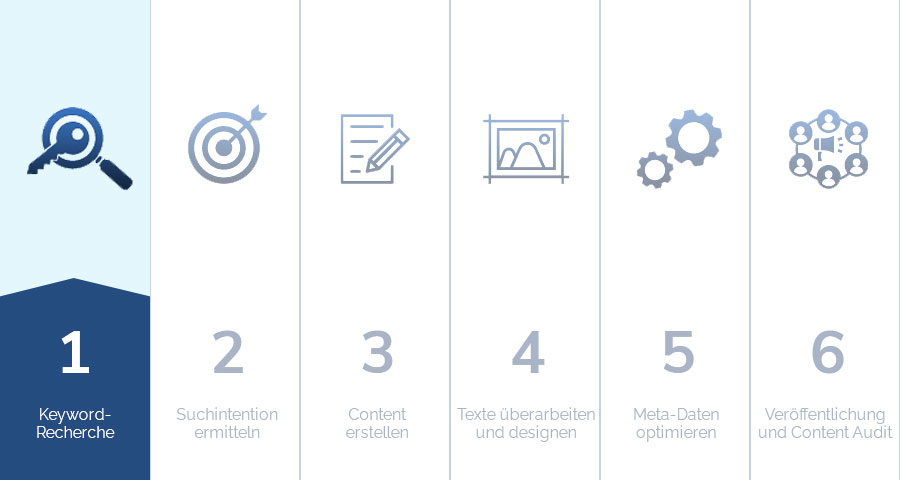
1. Keyword Research
Every SEO work begins with in-depth keyword research. This step must not be overlooked in your routine because it helps identify the right terms for your content.
1.1 What are Keywords?
Keywords are words and phrases that reflect your topic and are entered by users in the search bar. Google mainly works with text recognition and uses these terms to narrow down the content of a website.
Websites are rarely optimized for just one keyword but rather for several related terms. For example, an article about cat food can rank for keywords like "types of cat food," "what to look for in cat food," and "making cat food at home." So, your goal should be to identify all relevant terms for your topic.
1.2 Finding Keywords
There are various ways to search for the right keywords. It is advisable to use a keyword tool such as the Google Keyword Planner.
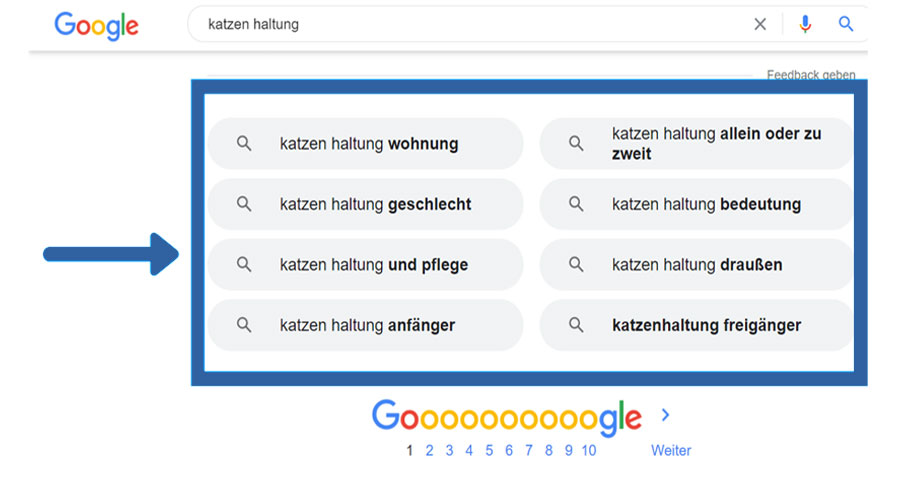
But you can also use the Google search itself for your keyword research. Simply enter your term in the search bar, and the search engine will automatically suggest other terms that are frequently searched.
Also helpful are the "Related Searches" displayed by Google, which can be found at the bottom of the results page and show keywords often used by users.
Here's an example for the keyword "cat care":
Keywords are typically examined based on Keyword Difficulty and Search Volume. Both can be shown by a suitable tool. Keyword Difficulty indicates how difficult it is to compete with the keyword because many other websites want to rank for it. Therefore, for generic terms that are often searched, the difficulty is correspondingly high.
Search Volume shows how often the term is searched within a month. It indicates how "in-demand" the keyword is. For a keyword with low difficulty and high search volume, ranking will be relatively easier.
Furthermore, there is a distinction between Short-Tail and Long-Tail Keywords. Short-Tail keywords are very short and usually consist of only one or two words (e.g., "learn dancing").
Long-Tail keywords are much closer to natural language usage and often consist of several words, even entire sentences and questions (e.g., "cleaning windows with household remedies"). Long-Tail keywords are more specific, making it easier to achieve top positions for them.
TIP: Check competitors as well as forums and social media to see which terms are frequently used in your industry.
1.3 Listing Keywords
It's best to collect your identified keywords in a list or transfer them to our KingCON Text Tool. There, you can see in real-time how many times you've used each term in the text and which ones you should reduce.
1.4 Creating a Keyword Map
Your website will likely consist of not just one but multiple pages. A Keyword Map is used to determine which subpage of your website should rank for which topic. Each page is assigned a primary keyword and several secondary keywords.
This structuring makes it easier to identify duplicate content and prevent a phenomenon called keyword cannibalization. This occurs when multiple pages of your online presence try to rank for the same keyword. Google then loses track of which URL corresponds to which keyword, and the ranking decreases for both pages.
You can create the map in a simple Excel table. In each column, you can enter the page type (e.g., blog article), the topic, the keywords, and the URL.
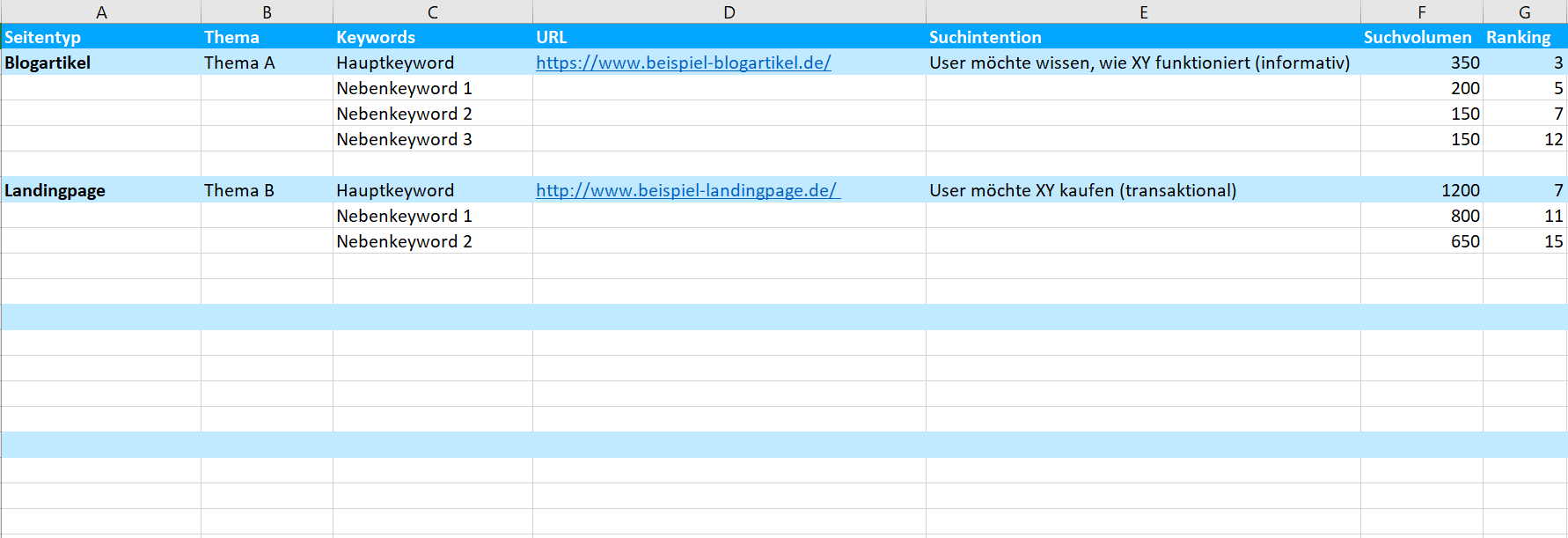
As seen in the example above, you can add any additional information to the table, such as search intention and current ranking.
2. Determine Search Intent
Search intent is the secret weapon for perfect content. With its help, you can create texts that deliver exactly what your users are looking for.
2.1 What is Search Intent?
Search intent is the ultimate SEO factor. It refers to the intention with which a search query is made on Google. You can read more about it in our detailed article on search intent.
SEO texts nowadays are highly user-centered. This means they provide users with precisely the information they need on a specific topic.
Here comes search intent into play. It describes what the user specifically expects from a search result.
2.2 Analyzing Competitors
A searcher may want to learn, make a purchase, or reach a specific location. To find out what questions they want to be answered or what specific information they are looking for, a thorough competitor analysis is suitable.
So, take a look at your strongest competitors on Google and analyze their website. Pay special attention to how the page is structured and what questions about the topic are answered.
If your competitor has content gaps on their page, you can take advantage of that by answering everything that is missing on your own website.
2.3 Define Target Audience
Note down the questions you have identified and also think about how you can thoroughly answer them. Put yourself in the shoes of your target audience as much as possible and consider what information you would want to receive from their standpoint.
TIP: Create a so-called Buyer Persona (a kind of fictional prototype of your users) for your offering in advance to gain even more insight into your target audience. You can find out how to create one in our article on Buyer Personas.
3. Writing SEO Texts and Creating Content
Successful content primarily requires text. We will show you what to consider when creating text content.
3.1 Choosing the Right Type of Text
Before you start writing, you need to define what type of text you need to create. The most common types of text are:
- Blog articles: Blog articles typically serve as guides on a specific topic and can also be presented as instructions or guidelines.
- Landing pages: Classic landing pages focus on a specific offer and aim to persuade the user to perform a conversion. This could be purchasing a product, signing up for a newsletter, or downloading an app.
- Lists: Lists are particularly popular for presenting information in a bullet-point format. When there are around 20 sub-points, they are called mega-lists, which can have up to 100 items.
- Reviews and product demonstrations: These texts are intended to reinforce the user's buying decision and should present all the advantages and disadvantages of a product.
- Whitepapers and PDFs: These documents usually contain technical discussions on a specific topic and are usually offered as downloads. They often provide important information on technical questions or give an overview of a product's features.
3.2 Organizing Content
After collecting all the essential questions about your topic, arrange them in a logical order. Before you begin the actual writing process, structure your text with meaningful headings and subheadings.
TIP: You can use marketing text formulas like AIDA to direct your users' attention and lead them step by step towards a conversion. Find out how to use this scheme profitably in our comprehensive guide to the AIDA principle.
3.3 Starting the Writing Process
Now, jot down everything that comes to mind about the topic and use short sentences and avoid excessive jargon. Write the text as clearly as possible.
Your text must absolutely cover all the important questions related to the topic. If you have a very extensive topic, use internal links that lead to articles with more information. This creates a holistic content that benefits not only your users but also becomes an important ranking factor for Google.
TIP: Pay attention to optimized anchor texts for your links. Instead of simply writing "click here" when linking to a page, use the keyword in the link text.
3.4 Unique Content
An important ingredient for your SEO success is so-called Unique Content, which means unique and original content. This means that your content, especially your texts, should not be copies of other websites. Google considers that as Duplicate Content, and it can lead to penalties.
You don't have to reinvent the wheel. It's enough to present the content in your own words and phrasing. An individual approach or providing new perspectives also count as unique content.
If duplicate content cannot be avoided (e.g., in product sorting in online shops), you can use a Canonical tag. This tag is placed in the header section of a page to indicate the "original" source.
It would look like this:

3.5 Incorporating Keywords
Your researched keywords should definitely appear in the text. Most of the time, you will naturally use your keywords, but there are some guidelines for keyword placement:
- In the H1 heading
- In the H2 and H3 headings
- In the first 100 words
- In the alt tag of images
- In the meta title
- In the meta description
- In the anchor texts of internal and external links
Placing keywords in these areas is still an important aid for Google to properly interpret the theme of the webpage.
However, you should avoid using your keywords excessively. This practice, known as keyword stuffing, not only harms readability but can also lead to Google penalties.
If you want to learn more about text creation, no problem. You can find the ultimate guide to SEO text creation in our SEO guide.
TIP: Our proprietary SEO Text Tool KingCON is specifically designed to optimize your writing process. With this program, even absolute beginners can write perfect texts. Give it a try!
4. Revising and Designing Texts
Now you need to revise and design your text. In addition to correct spelling and grammar, you should also ensure that your text is clear and has a professional appearance.
Here's a checklist for creating well-structured and clear texts:
- Short paragraphs (not longer than 5 lines)
- Tables, list items, and bullet points
- Images, videos, and graphics
- Bold highlights
- Adequate spacing between paragraphs (relaxes the eyes while reading)
TIP: Never publish a text on the same day you created it. There is a high risk of overlooking errors. It's best to let the text "rest" for at least a day and then revise it again.
4.1 Images and Videos
Graphical elements and images are particularly important because they can better convey emotions. Studies show that with pure text, only 10% of the information remains after one day, while with images, on average, 65% of the information is remembered even after three days (see: Verkaufspsychologie im Online Marketing, C. Tembrink).
Images are, therefore, much quicker to perceive and process than plain text. However, this only applies if the images also correspond to the content and the topic. If the image and text are entirely contradictory, they will miss their effect.
Consider whether you can present certain content as infographics and which images best represent your content. You can easily create such graphics yourself with programs like Canva.
TIP: Do not use too large image files as they can negatively impact the loading times of your website.
Another format that works very well is videos. Just like images, videos are very easy to consume and remain in users' memory for a longer time. Therefore, it may be beneficial to present certain content in video format instead of text.
4.2 Page Navigation
Your website should have a simple and intuitive navigation where users can find everything they need with just a few clicks and minimal scrolling.
Consider the user's eye movement and highlight the most important information.
TIP: Certain eye movement patterns can help you with design. The Z-pattern or Gutenberg diagram is well-known, where the user's attention is strongest at the top left and decreases as it moves down.
5. Optimizing Meta Data
The so-called meta data provides important information about the content of the webpage to search engines. This is achieved by using specific meta tags that are written in the HTML code of the webpage or implemented in the respective CMS (Content Management System).
The most important meta data includes the title and meta description. These are also displayed later in the Google snippet (preview of the webpage in search results). The title briefly and concisely represents the topic of the page, while the description briefly describes what the user can expect on the page.
Example for the keyword "Orchideen pflegen" (Caring for orchids) - This is how a snippet in the search results page looks like:
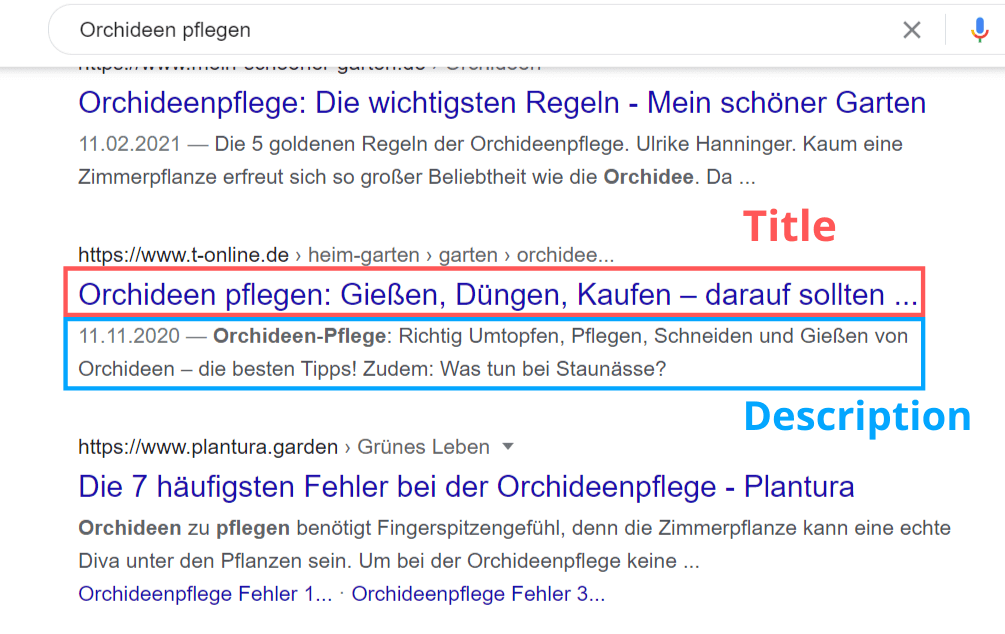
TIP: The title should not exceed 60 characters, and the meta description should not exceed 155 characters. Anything longer will be cut off by Google. Our SERP Snippet Generator shows you a preview of your meta data and provides valuable tips for snippet optimization.
Other tags that are important for SEO include:
- Robots tag: Specifies which content should be considered (or indexed) by the search engine.
- Hreflang tag: Indicates that there are multiple country or language versions of a content. This tells Google which language version of the webpage should be displayed. It prevents, for example, a user from Spain landing on a German-language page.
- Alt tag: This tag is the textual alternative to an image file. It is essential for visually impaired users as it allows screen readers to read the image content. The search engine can also better interpret what is depicted in an image using this tag.
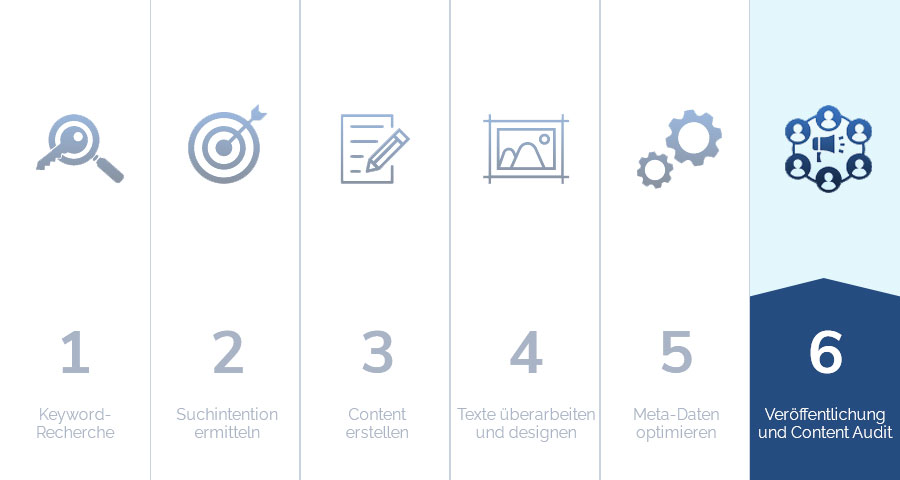
6. Publication and Content Audit
Naturally, you need to strategically publish your content. For blogs, it's useful to create an editorial calendar that specifies when each article should go live. Similar to the keyword map, this will give you an overview of your topics and prevent duplicate content.
6.1 Writing a Teaser
To attract as many users as possible to your content, you can tease the texts and posts on social media platforms. On platforms such as...
... you can generate attention for your posts and attract more visitors to your website. For tips on creating such teaser announcements, refer to our ultimate guide to SEO text creation.
6.2 Content Audit
Publication is not the end of the process. To maintain a consistently good ranking, you need to regularly update and revise your content. Depending on the topic, freshness is an enormously important ranking factor.
Therefore, take a look at older posts from time to time and try to incorporate news and updates from your industry into your texts as quickly as possible.
For assistance with this process, you can use tools like Screaming Frog or Google Analytics. The latter provides you with valuable data on the user behavior of your website visitors.
6.3 KPIs
The abbreviation KPI stands for Key Performance Indicator. These indicators are used to measure the performance of an SEO-optimized website and provide immediate insights into areas that need improvement. The most important metrics include:
- Search engine ranking
- Click-through rate (CTR)
- Number of page views (traffic)
- Conversion rate
- Bounce rate
- Number of (sub)pages per session
- Dwell time
- Load times
- Number of backlinks
TIP: When analyzing KPIs, always consider the (seasonal) context. Values may vary depending on the season (e.g., Christmas time).
6.4 SEO Check
To find out how your website is performing, you can also conduct an SEO check or analysis. In this process, a tool or SEO service provider will thoroughly examine your website and identify possible weaknesses in optimization.
We recommend our manual SEO check. Our specialists will thoroughly review your site and provide you with an individual report with actionable recommendations.
How Long Does SEO Take?
SEO doesn't work overnight and requires patience in the beginning. It can take anywhere from several months to a year before you see initial results. The timeframe depends on the scope of the online project and whether the website already exists or needs to be published.

Furthermore, SEO optimization is never really complete. If you want to be permanently successful, you need to regularly review your website and make necessary improvements.
SEO vs. SEA
As an alternative to search engine optimization, there is search engine advertising (SEA = Search Engine Advertising). With SEA, Google is paid to display the website in Google Ads.
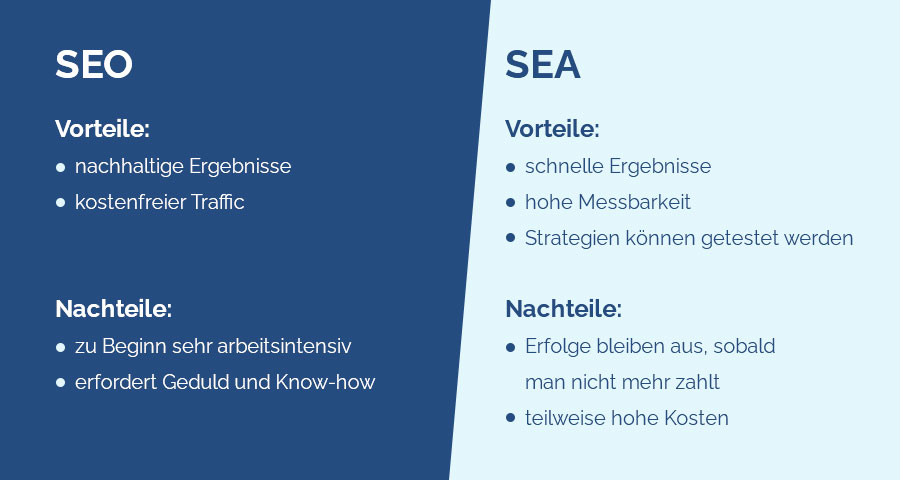
Google Ads can lead to a good ranking in no time. However, this is only true as long as you continue to pay for it. Once your advertising budget is exhausted, your good ranking will disappear.
On the other hand, with SEO, you can stay in the top rankings long-term and eventually generate organic traffic without ongoing payments.
If you want to find out which method is more lucrative for your website, we recommend taking advantage of our SEO consultation.
What is Black Hat and White Hat SEO?
In the field of search engine optimization, dishonest methods have also evolved over time to achieve better rankings. So-called Black Hat SEO refers to high-risk measures used to quickly achieve a top-ranking.
These include, for example, hidden texts on the website, link buying, or cloaking (where the search engine sees a different version of the webpage than the users).
These Black Hat methods violate Google's Webmaster Guidelines and can result in a Google Penalty (punishment).
The opposite of Black Hat SEO is White Hat SEO. This stands for all legitimate and ethical methods to increase rankings.
Latest News from the SEO Industry
SEO is constantly changing, so you should always stay up-to-date. The Google Search Central Blog regularly provides the latest information on SEO and Google search in general.
In our SEO Guide, you will also find ultimate articles and guides essential for your successful work as a marketer and search engine optimizer. Check it out!
Conclusion
Search engine optimization is the most important marketing channel for businesses with an online presence. You need to have some patience because mastering SEO requires months of research and practical implementation.
You also need an intuitive understanding of what your users and potential customers need, as that is the essence of search engine optimization. However, SEO is also a constant competitive battle that thrives on regular reviews and optimization efforts.
With our guide, you can take on this work yourself. But if you don't have the time or resources to do SEO on your own, feel free to contact us, and we will find a solution for you.
Frequently Asked Questions About SEO
What does a search engine optimizer do?
A search engine optimizer or SEO expert implements all the necessary measures to achieve a ranking increase for the respective online presence.
What is SEO marketing?
SEO marketing or search engine marketing is the umbrella term for everything that can be done to increase rankings on a search engine. This includes both SEO and SEA (Search Engine Advertising).
What does Google optimized mean?
Google optimized essentially means the same as search engine optimized. Many use the term because Google is the market leader among search engines.
What areas of SEO are there?
SEO can be divided into different areas such as Video SEO, Mobile SEO, Local SEO, Amazon SEO (or SEO for online shops), and Voice Search SEO. In our SEO Guide, you will find detailed information on each of these areas.
What is an SEO agency?
An SEO agency is specialized in making the online presence of businesses and online shops more visible on Google. Many business owners do not have the necessary time or resources to do SEO on their own, so it can be useful to turn to a suitable service provider. A good SEO agency can be recognized by using ethical White Hat methods and actively involving you, as the website owner, in the optimization process.
How much does SEO cost?
SEO costs vary depending on the provider, starting from around 1000 euros per month. Many working hours go into optimizing a website, which justifies these prices. The goal of SEO is the greatest possible ROI (Return on Investment). This means that while you initially have to invest in SEO, this investment will pay off in the long run as you eventually generate free traffic and can make more sales.
What is an SEO check used for?
An SEO check or analysis serves as an assessment of your online presence. Your website will be thoroughly analyzed, and weaknesses in the optimization will be identified. This way, you will know immediately which areas are not performing well enough and can steer your efforts accordingly. If you're interested in such an analysis, we recommend our manually conducted SEO Check.