
Search Intent:
Success with Understanding!

Klaus Huber
12th February 2021
Do you want your content to make an impact like a bomb? Yes? Then we have the perfect secret weapon for you: Search Intent.
While the competition still tries to climb the rankings with simple keyword lists, you can achieve sensational results with Search Intent - Our ultimate guide shows you how it works.
What is Search Intent?
Search Intent refers to the intent behind a query made on a search engine. Google defines the term as follows:
"When a user types a query, he or she is trying to accomplish something. We refer to this goal as the user intent."
So, when we type a term into the Google search bar, we expect a specific result. We want to find information, make a purchase, or get to a particular place.

Let's say you want to buy a coffee table for your living room online. You don't want just any coffee table; you are looking for a specific one. You might search for "buy designer coffee table in brown" or something similar.
Now, ideally, you would like to land on a website that sells exactly the type of coffee table you like, right? You want to see a wide selection of brown designer coffee tables. That is your Search Intent.

In this example, Google also correctly identified the Search Intent and provided a list of online furniture shops in the search results.
Why SEO Doesn't Work Without Search Intent
We use the internet because we want to find relevant information quickly.
But the search results shouldn't just be relevant; they should be perfectly tailored to our needs. Google, therefore, strives to rank pages at the top that are most likely to fulfill the searcher's purpose.
Google does this not just out of kindness but because satisfied users are a lucrative revenue source for the company. They keep coming back, generating advertising revenue.
More searchers mean more ad sales. While the majority of search results are organic (not paid), Google still wants to deliver the best results.
What about website owners? They want to attract customers and save on advertising costs. That's why they also want to be highly ranked in organic search results. The best way to achieve that is by optimally serving the Search Intent.
How does Google determine if the Search Intent is met?
Whether the Search Intent is met or not, Google measures it based on the so-called user signals. User signals essentially refer to any interaction the user has with a webpage. Metrics such as click-through rate, time on page, and scroll depth can indicate whether the user finds the webpage appealing.
In contrast, a high bounce rate and pogo-sticking (immediately returning to the search results page) are signs that the webpage does not provide value to the user. Google recognizes this and ranks the relevant webpage lower.
Search Intent vs. User Intent
The term Search Intent is often used interchangeably with User Intent, but Search Intent is actually only a small part of User Intent.
- User Intent is the overall reason why we use a search engine in the first place. We have a specific goal in mind.
- Search Intent is the intention behind a specific search query, which usually arises from User Intent.
Here's an example:
You want to learn how to draw. That's your User Intent. Before you start a Google search, you might take some other steps, like picking up a pen and paper and trying a few sketches first.
After attempting a few drawings and not being satisfied with the results, you turn to Google and type "learn to draw." That is now your Search Intent. You could describe it as "I want an explanation of the best way to learn how to draw." Google will provide you with tutorials and videos to fulfill your need.
A User Intent can lead to multiple Search Intents. Once you have improved your artistic skills, you might conduct a search like "buy sketchbook" or "buy art supplies online."
Your Search Intent now is "I want to buy art materials." Now you want to find a shop that offers art supplies.
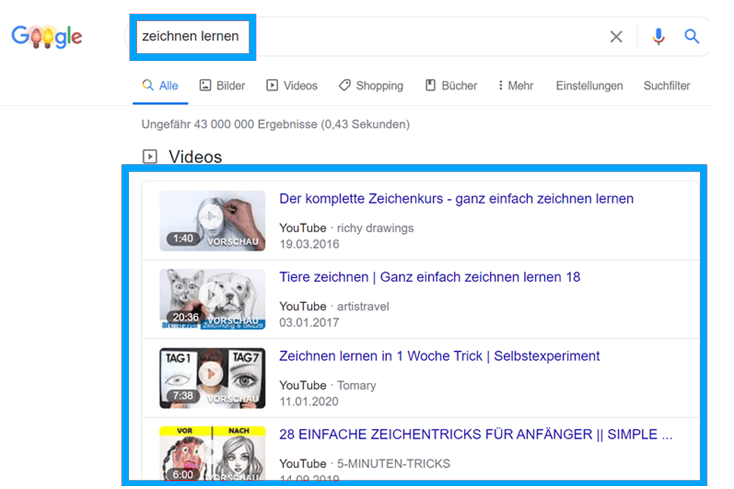
You see: Your individual needs have also changed your Search Intent.
By the way, the journey from "I want to learn how to draw" to "I'm buying art supplies" is called the Customer Journey. It involves recognizing a lack, seeking information, and eventually becoming a buyer. Typically, the Customer Journey consists of five different stages:
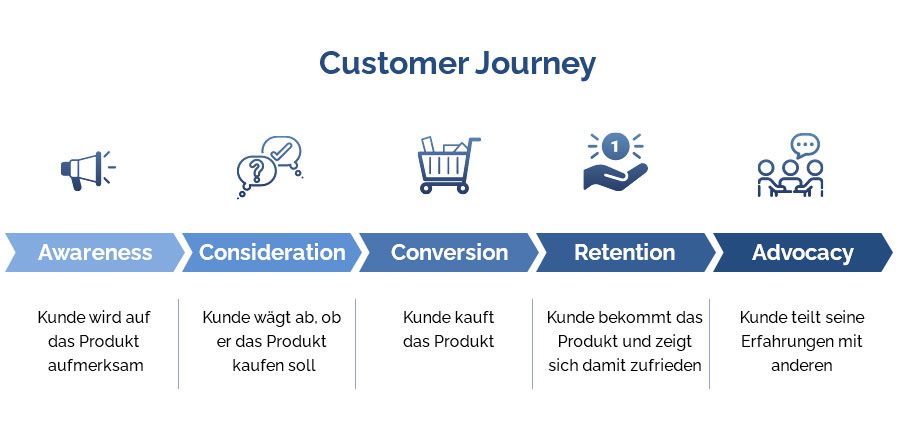
The task of every website owner is to engage the user at the right phase of the Customer Journey and adequately address the respective Search Intent.
This is not an easy task since the boundaries between the individual stages are often fluid. If you want to learn more about this topic, you can read our article on Customer Journey.
What types of Search Intent are there?
Behind each keyword, there is a different Search Intent. In 2002, computer scientist Andrei Broder proposed a categorization.
- Transactional Searches = "I want to do something": Transactional searches can refer to actions like purchasing a product, downloading something, or signing up for a newsletter. These search queries often include words like "buy" or "order."
- Informational Searches = "I want to know something": In this type of search, the user seeks information about a particular topic. It could be information about specific individuals, places, or things. The range goes from "angela merkel age" to "salad nutrients." Google users often ask for solutions to specific problems by formulating questions like "what do I do for xy."
- Navigational Searches = "I want to go somewhere": In navigational searches, the user wants to access a specific webpage but may not know the exact URL. For example, they might simply type "amazon" or "facebook" into the search bar. Company names or brand names are also frequently used in this type of search.
Google has also made its own categorization of Search Intents, which are divided into "Know", "Do", "Website", and "Visit-in-person" searches:
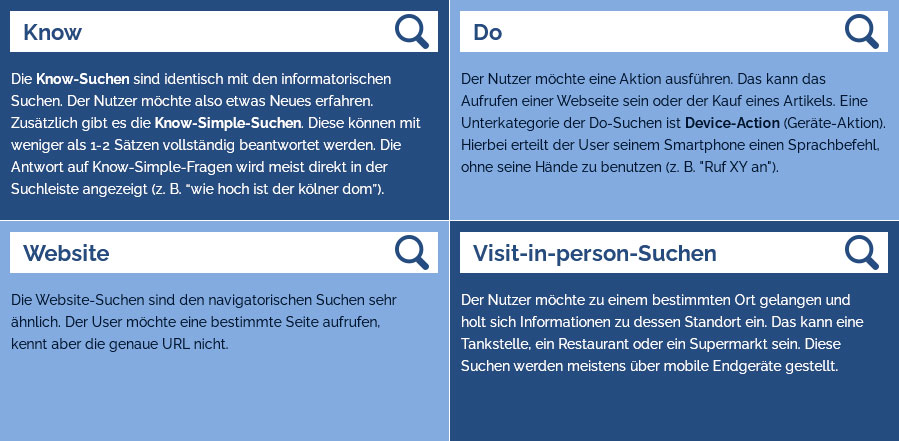
The distinctions are not always black and white. In fact, there is usually more than one intention at play.
For example, when someone searches for "buy a bicycle," they know they want to buy a bicycle (transactional) - but that's about it. In most cases, they also want to know what to look for before making the purchase (informational) and where they can buy the right bicycle (navigational).
So, it's essential to have a general understanding of what information the user needs rather than strictly categorizing it.
Understanding and Identifying Search Intent
To correctly identify Search Intent, you need to put yourself in the shoes of the searcher. Imagine you were in their situation. How would you react?
These questions can help you with that:
- What is the searcher's need? Searchers might be looking to get information, be entertained, or make a purchase.
- What doubts might they have? Perhaps they want information about the effectiveness of a certain product or are unsure about something.
- What goal do they want to achieve? They might want to download an app or sign up for a forum.
- What keywords would they use to search? Ensure that your keywords match the "natural" way people speak. Even a CEO looking for customer acquisition software for their company might not search for "CRM" but rather "customer acquisition program."
- From which device are they searching? Google places significant emphasis on mobile devices, so your website must be easily readable on mobile phones as well.
Don't overcomplicate it; think logically about how you would solve the problem at hand in that situation.
The Psychological Aspect of Search Intent
We humans have different needs and thus different motivations. Accordingly, we shape our actions.
When we type a search query into Google, we also want to satisfy a need. Often, these needs are not even consciously aware to us.
To identify the needs your users want to fulfill, the so-called hierarchy of needs by American psychologist Abraham Maslow can be helpful. This model illustrates human needs step by step and is widely used as a basis for marketing strategies.

Aside from basic necessities like food and sleep, we seek security, social inclusion, and self-realization.
You can also make use of this model for your SEO content. If you are looking for the right Search Intent, ask yourself two fundamental questions:
- What need could the searcher have?
- Which need can I actually fulfill with my content?
Especially social needs can be addressed in your texts. For example, customers might feel a sense of belonging to a group through the purchase of a product.
Determining Search Intent - Here's How!
Now let's get to practice. The best way to determine Search Intent is through a comprehensive competitor analysis.
SERP Analysis
First, enter your keyword in the Google search bar. It's best to clear your cache beforehand or use incognito mode to get as neutral search results as possible.
We've summarized a few helpful questions for you:
- What elements are displayed in the direct field of view (Above The Fold)?
- Is there a knowledge graph? (usually informational)
- Are there shopping results?
- What search suggestions does Google make?
- Are there user questions?
- Does a date appear in the snippets? (indicates that freshness is important)
- Are there star ratings?
- Is there encryption in the form of HTTPS?
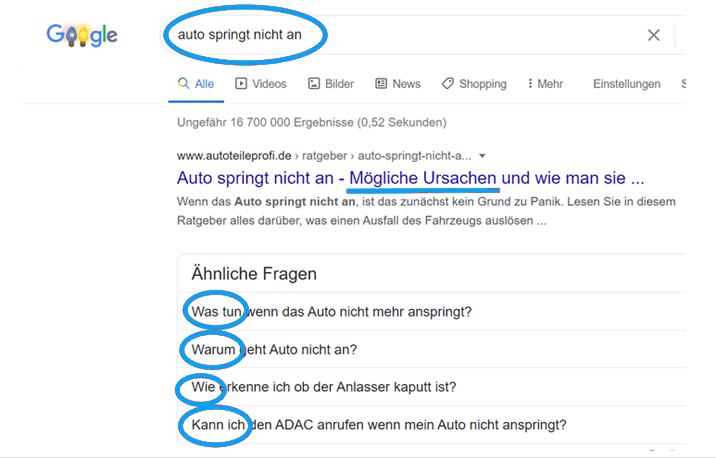
Here is an example for the keyword "car won't start." Analyze the key points and overlaps. It could look like this:
- Questions about the cause: Why won't the car start? How do I recognize the problem?
- Questions about problem-solving: What should I do/what can I do?
- No ads and Google user questions in second place = informational
- Conclusion: The user wants to quickly find a solution to their problem
What the top results have in common is often what leads to success.
Website Analysis
In another step, carefully examine the content of the websites, at least the top 5.
- What do the websites have in common?
- How is the content structured?
- Where are there gaps/where would you like to find more information?
- What goals can the user achieve by interacting with the website (e.g., signing up for a newsletter or making a purchase)?
- How is the content visually presented?
- Where and how are call-to-actions placed?
Take note of everything that comes to mind, for example, in an external document. Every detail can be important later, so write down all your impressions.
Caution with Keyword Formulation
For readability, it is perfectly fine to reformulate your keywords. However, in terms of search intent, this can sometimes go awry. Grammatical adjustments can lead Google to interpret the search intent differently.
Take the example of "lineal."
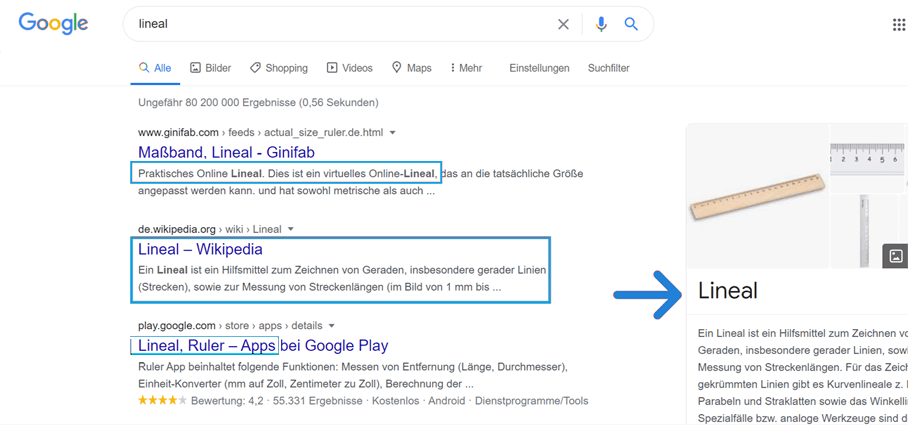
When you enter only "lineal" in the search bar, you mainly get informational results and offers for online rulers or ruler apps.
However, with the plural version "lineale," it's a different story.
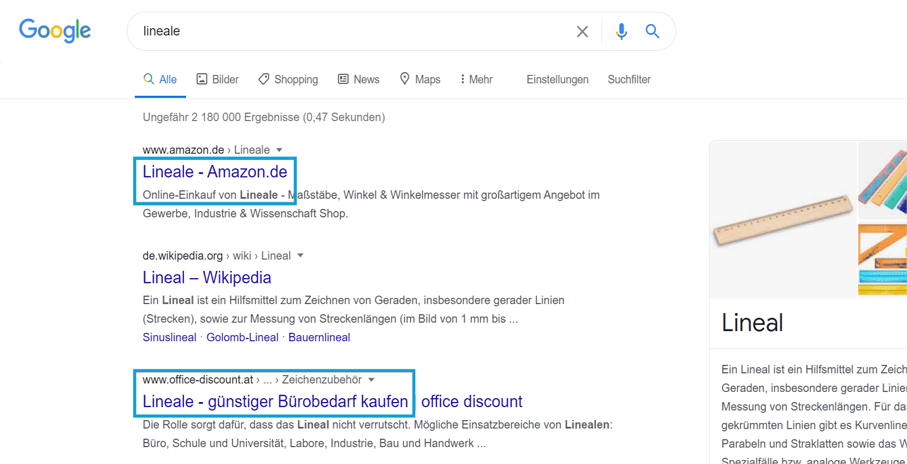
Here, Google seems to suspect a transactional search intent and suggests online shops where rulers can be purchased.
As you can see, the algorithm for some terms is not perfect in estimating exactly what the user wants. So be cautious when reformulating your keywords and check each one for any deviations in search intent.
"Jeopardy" and Search Intent
Are you familiar with the American quiz show "Jeopardy"?
In this format, participants must find questions to the answers given, rather than the other way around. This principle also works brilliantly for determining search intent.
Examine the content of the top results carefully. Consider what questions you could pose to the content. What answers does the website provide? If there are overlaps in your analysis, you can use them as a guide for your own content.
Don't Forget About the Visuals
Determining and catering to search intent is essential for optimal visibility of your website. However, the content truly becomes outstanding when the design of the website is also on point.
A beautifully designed and easily readable website is more engaging for users and remains in their memory much longer than plain text. This is because graphical elements appeal to us emotionally.

Here, too, you can orient yourself with the top results:
- How is the content presented?
- What is the page layout?
- Is the content well-organized?
- Are videos, images, and graphics used?
- Where are specific pieces of information located on the website?
The first impression must be convincing, as users often decide in just a few seconds whether they will explore the website further or not.
Regularly Check Search Intent
The search intent behind a keyword is not set in stone and must be regularly checked. Therefore, periodically review the results for your keywords and keep an eye on current trends. This way, you can ensure that you always deliver up-to-date content.
Ape-strong SEO Success with KingCON

If you want to make your competitor analysis even easier and create profitable content even faster, then we have the perfect tool for you.
Our ultimate SEO text tool, KingCON, comes with an integrated competitor analysis feature. The program automatically identifies questions that your users have about the topic, saving you a lot of manual research work for your SEO text.
KingCON is specifically designed to make your text creation as efficient as possible and to stay one step ahead of your competitors.
Try it out and request a free demo now!
Conclusion: Search Intent = SEO
You now understand why search intent is so important and how to recognize it. Finding out with what motivation users come to your site is not just a trend but a fundamental requirement for your online success.
Here are the most important steps summarized for you:
- Identify the information your users need.
- Determine content gaps: What content is missing among the top competitors?
- Create the appropriate design for your content.
- Regularly check the search intent.
Of course, search intent cannot always be determined with 100% accuracy. However, it is not necessary if you fundamentally understand what internet users expect from your website.
Stay up to date with us: Our articles are continuously expanded and regularly updated.