
SEO Text Creation:
The Ultimate Guide to Do It Yourself!

Klaus Huber
20th January 2021
If you want to learn how to write perfect SEO texts, you've come to the right place: In our step-by-step guide, we'll show you how to create a convincing and user-centric text that will boost your website's ranking.
What is an SEO Text?
In essence, it's an online text that aims to achieve a high ranking on Google by providing users with the maximum benefit. In other words, it's a text that not only appeals to readers but also to the search engine.

The Google algorithm takes into account numerous factors that identify the text as relevant to its users, including comprehensive content and the placement of keywords. So, you need to consider certain things to make sure your text is approved by the search engine.
It doesn't matter whether you're writing a blog article, a product description, or a guide. The goal is always to be understood and placed high by Google.
Now, let's show you what it takes to create a perfect text.
What Makes Successful SEO Texts?
In search engine optimization, there are specific factors that distinguish an SEO text as "good." Here are the key criteria for you:
User-Centric Approach
Successful SEO texts offer added value by being perfectly tailored to the user and their needs. This means providing the information the user requires for their specific situation. If users want to know how to build a bookshelf, a successful text will explain how to craft such a piece of furniture in a step-by-step guide.
Theme Optimization
The times of overloading SEO texts with as many keywords as possible and turning them into endless blocks of text are long gone. Google is now capable of recognizing content-related connections without the need for the keyword to be repeated in every other sentence.
For this reason, SEO texts must be primarily theme-optimized and well-written in a understandable manner. While keywords are still essential for the search engine, they can be easily substituted with synonyms or grammatically adjusted.
Accuracy
Content accuracy is an important ranking factor for Google and essential for readers. This applies to every text, but especially for topics that could impact a person's health or financial situation (so-called "Your Money, Your Life" - YMYL content).
Unique Content
Google does not appreciate copies of content from other websites. Your content must be unique in one way or another. This can be achieved by introducing new methods and terms or using individual phrasing.
Why Do I Need SEO Texts on My Website?
SEO texts constitute the lion's share of good content. Google primarily relies on text recognition and evaluates the relevance of a website based on the readable content it contains.
The algorithm is continuously improving in recognizing useful pages that provide users with added value and ranks them higher accordingly.
Thus, having good SEO texts is a lucrative method for increasing your visibility on the web and generating more prospects for your offering.
So, if you want to create good and user-friendly content that is actually read,
Yes? Let's delve into it now.
Step-by-Step: How to Learn to Write Perfect SEO Texts
Now, let's get down to business. In our comprehensive guide, we provide you with the necessary know-how to optimally plan, write, and design your text.
Step 1: Research
Every SEO text begins with extensive research and data collection on your topic. Here's how you should approach it:
Choose the Type of Text
First, clarify the type of text you'll be writing.
There are different SEO text formats, such as:
- Blog posts that thoroughly cover a topic and can also be designed as guides or tutorials.
- Lists and bullet points that present the key points of a topic in a concise manner.
- Landing pages that focus on a specific offer and aim for a conversion (purchase). Here, you present all the important arguments for your product or service.
- Product reviews for specific products, highlighting all the pros and cons of an offering.
- PDF content (e.g., whitepapers) representing an in-depth technical discussion on a topic, available for download.
You should also distinguish between texts that thrive on timeliness (e.g., news articles) and "evergreen" content, which hardly changes or does not change at all (e.g., tutorials). The former requires more frequent updates than the latter.

Conducting Keyword Research
Keywords are the search terms that users use to obtain information on a specific topic. Therefore, before you start writing, you need to conduct thorough keyword research.
Why? Because keyword research shows you with which terms users search and how frequently they do it (search volume) each month.
For research, you have several options. You can use tools like the Google Keyword Planner. There, you can see all the data about your keyword at a glance, such as the aforementioned search volume and keyword difficulty. The value from 0 to 100 indicates how difficult it is to compete with this keyword, i.e., how many competitors want to rank for the same keyword.
TIP: With a high keyword difficulty (above 30), you can check the first three result pages for your keyword and see which additional keywords are being used. These usually have a lower difficulty level.
For example, if you want to rank for the keyword "hose" (pants), it won't be easy because countless websites and online shops optimize their content for this keyword.
In such cases, it's better to choose a so-called long-tail keyword. Long-tail keywords refer to more specific niche topics. For instance, a long-tail keyword for "hose" could be "cord hose brown".
You can also utilize Google search suggestions. Simply enter your keyword into the search bar and check the suggested terms.
Here's an example for the keyword "Spargel schälen" (peeling asparagus):
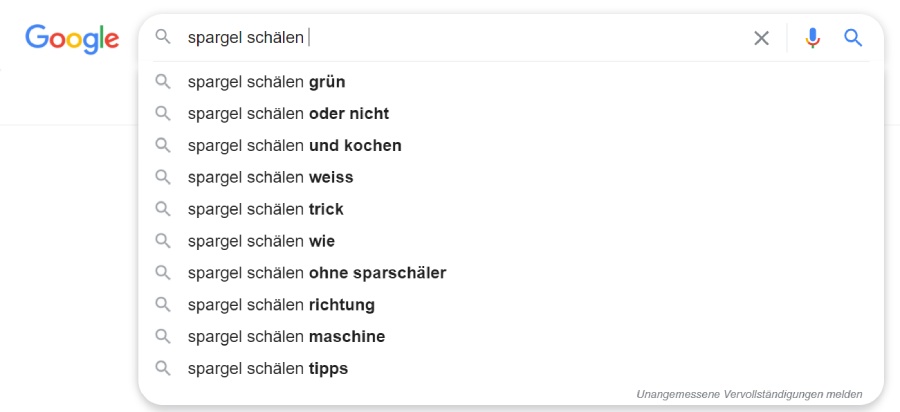
These terms not only provide keyword suggestions but also give you an indication of the specific information users are searching for.
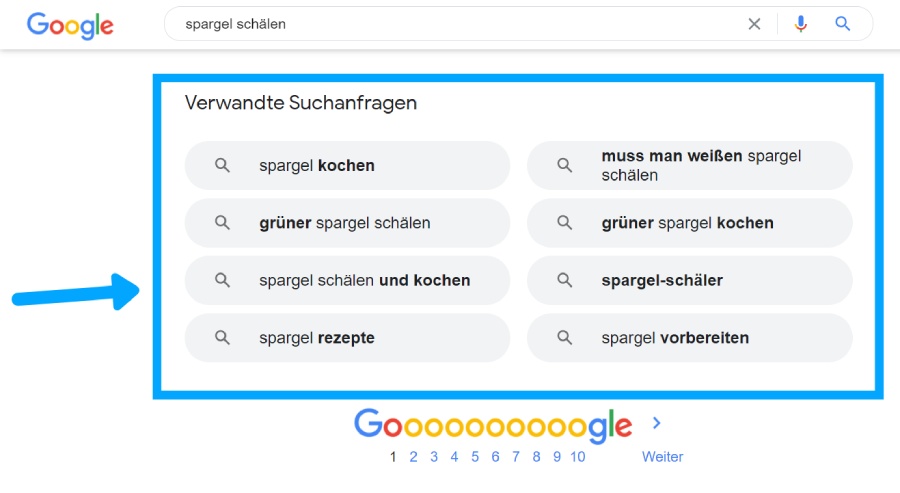
Once you've found your main keyword, it's best to identify relevant secondary keywords that complement your topic. Again, you can use the automatic search suggestions or related search queries at the bottom of the search results page.
Also, check whether your keyword is local (e.g., a specific restaurant) or global. For local keywords, your content should be optimized for the specific region. This means you should highlight local visitation options, opening hours, provide directions (Google Maps), or mention local specialties.
For more information on this, check out our article on Local SEO.
Once you have gathered a significant number of relevant keywords, compile them into a list. For this purpose, we use our SEO Text Tool KingCON. There, you can easily insert keywords and keep track of how often you've used them while writing.
Note Down Questions Related to the Topic
Next, identify relevant questions related to your topic. Programs like our W-Fragen-Tool can be helpful for this purpose.
Moreover, Google user questions can be of great assistance. These questions are generated by Google itself and can be found relatively high up on the search results page under "Similar Questions".
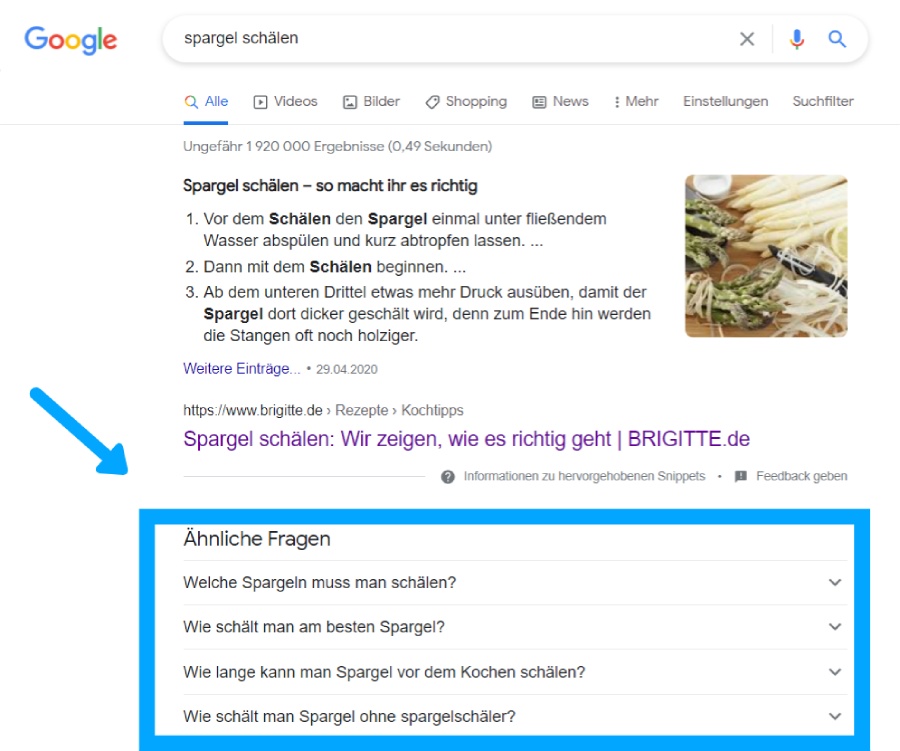
Write down all the questions that come to mind regarding your topic. These will serve excellently as subheadings within your text.
TIP: Are there any relevant studies on your topic? If so, cite them in your text as it will enhance the value of your content.
Determine Search Intent
The search intent is, in simple terms, the intention with which someone enters a search term. So, if you search for "schokoladen kekse rezept" (chocolate cookies recipe), your search intent is probably "I want to bake chocolate cookies myself, so I need a recipe."
Google considers websites that fulfill the respective search intent as particularly relevant and rewards them with a good ranking.
Therefore, be conscious of what the user might want when entering your keyword and try to deliver exactly that in your content.
If you want to learn more about search intent, we have the appropriate article on search intent for you.
Competitor Analysis
At this point, it's essential to find out how your competitors are addressing the topic. Enter your term in the Google search bar and examine the top search results for your keyword (at least the first 5):
?
How are the websites structured?
Which sub-topics are covered?
What is the design of the content?
Where are CTAs placed?
Where are there content gaps?
TIP: With KingCON, you can easily find out for which keywords the top results are still ranking. This way, you can discover content that you can also incorporate into your content to illuminate your topic even better.
With the collected notes, you already have an idea of how you can present your own content. Pay particular attention to whether your competitors have overlooked anything and include that in your text. This way, you'll always be one step ahead of your competition.
Step 2: Create the Text Structure
You have a mountain of collected information, but what now? After all, you want to include everything, but not overwhelm your users. The top priority here is to create a clear and structured layout. For a text to captivate the user, they must quickly find their way around it.
It's best to organize your text into the classic three sections that you know from school: Introduction - Main Body - Conclusion.
- Introduction: Make it intriguing and grab your audience's attention: What is the problem? How is the reader affected by it? How can you solve the problem?
- Main Body: Present the solution to the problem, logically divided into steps or bullet points.
- Conclusion: Summarize the most important aspects. Possibly include a Call-to-Action, encouraging your readers to take a specific action.
TIP: Name your conclusion "Conclusion". Many users jump to the summary first before reading the entire text.
Create Appropriate Headings
Always divide your information into meaningful headings and subheadings to help your readers navigate through the text easily.
The arrangement of your headings must be logical, and they should precisely indicate what the respective paragraph contains. Later, these headings will become part of a clear table of contents.
These headings will later be part of a clear table of contents that facilitates navigation for your readers.
You can write the main heading either at the beginning or at the end of the writing process. It's essential that the heading sparks interest and promises the reader a benefit. Ensure that the heading is not too long but still reflects the content of the text.
Create an initial outline for your text with the main headings and sub-points. This will help you later during the writing process.
At this stage, you should have your outline and the gathered information reviewed and approved by the management or your content planner. They can fill in any potential gaps and provide feedback. After that, you can begin writing.
Step 3: Write the Ultimate SEO Text
Now it's time to start writing. With the collected information and the right structure, this step should now be easier for you.
Write down everything you've gathered as information. Don't get stuck on specific passages. You can revise everything later.
TIP: If you like, you can set a timer for 10 to 20 minutes and write down everything that comes to your mind during that time. The fine-tuning comes afterwards.

The first draft doesn't have to be perfect. A truly great text emerges through constant revision.
Pay Attention to the Writing Style
It's invaluable for your users that the text is easy and fluid to read. By following a few simple rules, you can ensure your text has good readability:
- Avoid long, convoluted sentences. Get to the point and write precisely.
- Passive constructions are long and cumbersome to read. Active voice, on the other hand, is engaging and easy to consume.
- Vague descriptions only confuse the reader. Opt for concrete statements.
- Don't overuse technical jargon. Instead, use terms that are easily understandable. If you use technical terms, explain them immediately. Someone who is confronted with many incomprehensible words right from the start will not want to continue reading.
- Engage the reader by directly addressing them in the text (e.g., through questions).
Use Keywords
Of course, you need to include your keywords in the text. However, don't overdo it and avoid keyword stuffing (excessive use of keywords).
In the past, the so-called keyword density was used as a guideline for SEO texts. It indicates what percentage of the text consists of keywords. The problem with this approach is that a high keyword density primarily serves search engines and impairs readability.
So, don't forcefully insert keywords too frequently, as it will make your text difficult to consume.
However, there are a few general rules for keyword placement:
- In the H1 heading
- In the H2 and H3 headings
- In the first 100 words
- In the alt tag of images
- In the meta title
- In the meta description
- In the anchor texts of internal and external links
Always prioritize natural readability. The key is for Google to understand the context, which can also be achieved through synonyms and related terms.
How Long Should My Text Be?
This topic is a matter of debate. Many SEO agencies claim that a specific number of words is optimal and come up with the wildest formulas regarding the ideal text length.
But the truth is: Text length alone is not a ranking factor for Google.
If long texts with 3000 words or more rank well, it's because they are consistently well-optimized. If you write a perfectly optimized text with 1000 words and then expand it with an additional 500 words, it won't give you a better ranking.
So, there is no optimal text length. The length of the SEO text depends mainly on the type of text and its content. The most important rule here is:

If the topic allows it, feel free to go well beyond the 3000-word mark. However, don't unnecessarily lengthen your content.
Write a Teaser That Creates Curiosity
You have created the perfect SEO text and want to attract attention from internet users? Then write a teaser that makes potential readers curious and entices them to click on your SEO text.
What is a teaser? A teaser is a short text that stimulates interest and encourages people to click on your article.
These short texts are usually published on social media platforms and are the first thing readers see before they access your article. Feel free to experiment with witty or slightly provocative statements.
Here are some ideas for crafting a teaser:
- Pose relevant questions to the readers
"How can you become self-employed within a year?"
- Make a promise
"Save 15 hours of work per week with this productivity method."
- Challenge the readers
"Can you master the basics of web design in 5 hours? We'll prove you can."
- Personalize your users and highlight who your offer is suitable for
"Attention, marketing specialists! This method increases your revenue by 100%!"
The reader must immediately understand what your text is about. Use mainly short main sentences and express yourself clearly.
Master the Art of (Sales) Psychology
You want your texts to have an impact, right? Either you want the user to make a purchase, or you want them to see your content as the optimal source of information.
If you want to write an effective SEO text, you must understand the wishes and needs of your readers.
The hierarchy of needs by the US psychologist Abraham Maslow is one of the most well-known psychological models and shows the human needs. It is commonly used in marketing to understand the motivation behind a customer's actions.
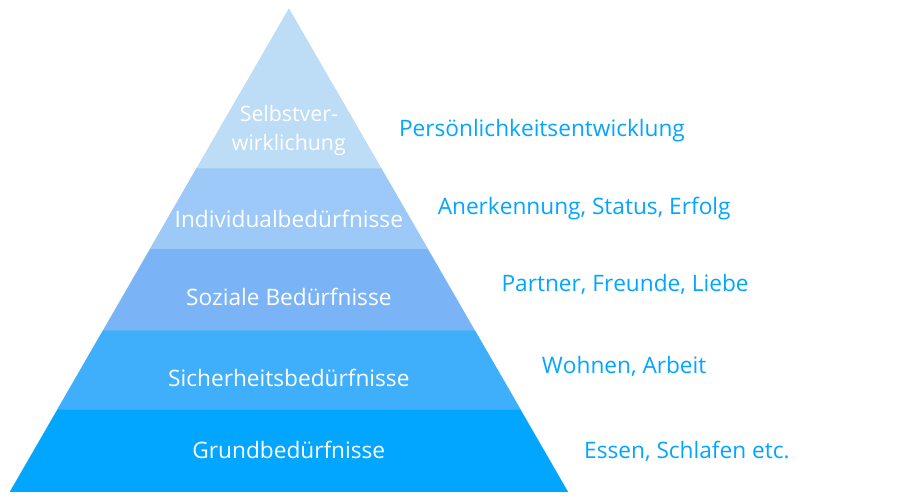
Maslow categorizes the first three levels as deficiency needs, which include essential basic needs such as food and sleep, safety needs like suitable housing, and social needs such as friendship and closeness.
The last two levels are labeled as growth needs. Unlike deficiency needs, these can hardly ever be completely satisfied.
For SEO-optimized texts, what is particularly important are the social needs, which include the desire to feel like part of a group and socially connected.
This model can give you the necessary insights if you want to know how your text should impact the reader. During a brainstorming session, consider:
- What might motivate my readers?
- How do I want my users to feel?
- Which needs can my content satisfy?
The way you write a text and formulate your sentences also affects your readers. Here are some simple rules to write compelling sentences:
- Positive phrasing: Our brains dislike negations because they take significantly longer to process. When reading quickly, the negation might even be ignored. In that case, the opposite of what was written is understood. This applies to words like "not," "no," and negative verbs like "avoid" or "refrain." Formulate your texts as positively as possible.
- Variety: Monotony bores readers. Provide variety by using short and simple synonyms. Vary sentence length or include questions.
- Questions: This leads us to the next point. Ask good questions in your text. Questions activate your readers, as a question always motivates finding an answer. This means your audience feels engaged and involved in the content.
- Identification: If the user feels like saying, "That's me!", then you've done everything right. Your readers want to feel included and will appreciate it if the topic is related to them.
- Reasoning: We humans want to understand everything. And what do we need for that? Reasons. When we understand the connections, we are much more willing to take action. Use conjunctions like "because," "therefore," and "for this reason."
- Show transparency: This builds trust with your audience. Show how you work and what difficulties you've faced. You can also tell how you overcame these obstacles. Keep the expectations for your product or service realistic. This method makes you appear human and empathetic. It shows your readers that they are not alone with their problems. You can also include evidence of your reliability in your text. Testimonials, certificates, or reviews are effective means.
- Use strong words: Strong words (or power words) are those that appeal to the emotions of your users. Terms like "unique," "joy," or "quality" can emotionally activate your readers. Orient yourself to your target audience and search forums or comment sections to find words that your readers use.
- Address benefits: Don't forget to address the benefits of your product or service. Readers want to know what positive things they can expect.
TIP: Our article on sales psychology provides you with all the information you need on this topic.
AIDA
The abbreviation AIDA stands for "Attention," "Interest," "Desire," and "Action," representing the stages of Attention, Interest, Desire, and Action (or purchase) in marketing.
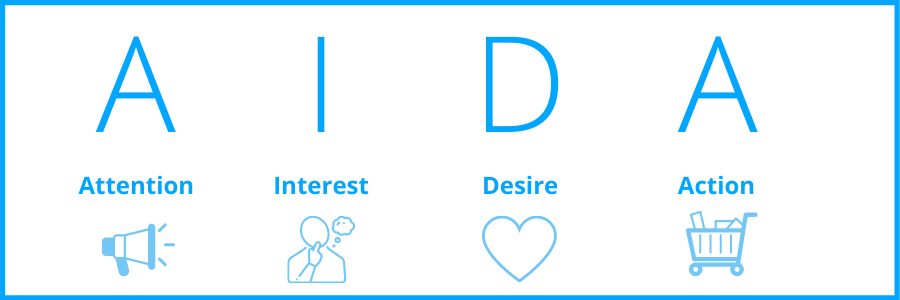
It is a marketing model that illustrates the different customer phases from initially capturing their attention for a product to ultimately leading them to make a purchase.
Attract attention and generate interest with a compelling headline or teaser. Activate the user's "desire" by appealing to their emotions and demonstrating the benefits of your content. Guide your readers to take action and motivate them to make a purchase.
If you want to know how to perfectly apply the AIDA formula in marketing, take a look at our comprehensive guide on the AIDA principle.
Share Your Expertise
This is especially true when you write informative SEO texts. Don't hold back with all your information; share some tips and tricks that can be helpful to your readers.
Describe how you organize your work process to inspire your users. Your audience will be grateful for these "insider tips."
Work with Topic Clusters
To give your content the necessary depth, you can work with topic clusters or pillar content. This approach is particularly useful for blog articles.
Start with the main topic of your website. The article on this topic should be very comprehensive and cover the essential points. From this article, create internal links to other related articles. This way, you create an extensive network of information that answers all questions related to this topic.
The main article will rank for the main keyword, and the supporting articles will rank for relevant long-tail keywords. You can regularly update and expand this structure.
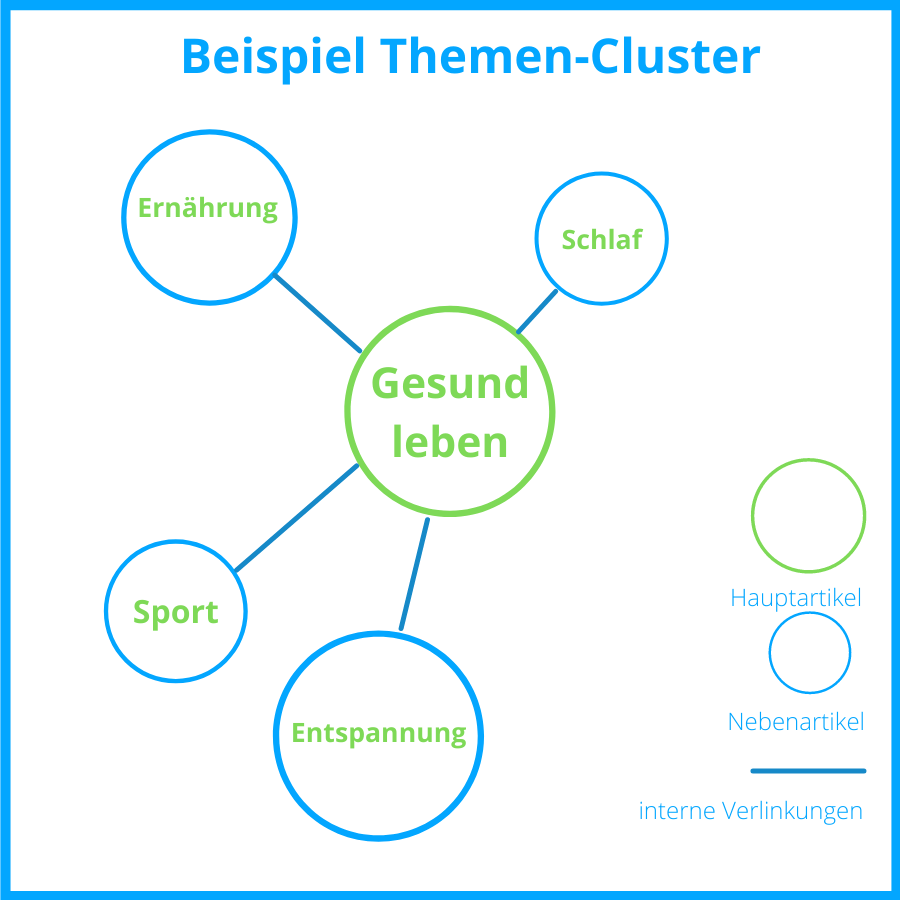
This is how a cluster for a blog about "Healthy Living" could look like.
With this approach, you not only ensure a good link structure but also provide comprehensive coverage of the topic, which will please your readers and benefit your ranking.
Schritt 4: Überarbeiten und Designen
After creating your text, you should not publish it on the same day. Otherwise, you run the risk of not noticing any errors or issues.
It's best to let the text rest for one to two days after writing it and then start the revision process.
Correct Your Text
Now that your text has rested for a while, begin the correction process. This step will turn the rough draft into a polished gem of a text.
- Check your text for gaps in content and logical arguments. Don't hesitate to trim down passages that are unnecessary. Also, split up long sentences to improve readability.
- This is also the time to come up with a compelling headline if you haven't done so already.
- Eliminate unnecessary filler words and word repetitions. Get rid of anything that unnecessarily lengthens your text.
- Don't forget to run a spell-check program over your text to catch any remaining errors. Alternatively, you can have someone else proofread it.
Before publishing, compare your text again with the top-ranking pages. Is your text better? Is there anything else you can add?
Optimize Snippet and Meta Data
The snippet is a preview of your webpage displayed on the search results page. It's the first thing your users see before clicking on your text.
The snippet should be short and concise, with the main keyword preferably placed upfront.
The meta description provides your users with a first insight into the content of your article. It should accurately describe what your text contains, but it shouldn't be too long (maximum 160 characters).
Anything longer will be cut off and won't be visible. You can also use symbols and emojis in the meta description.
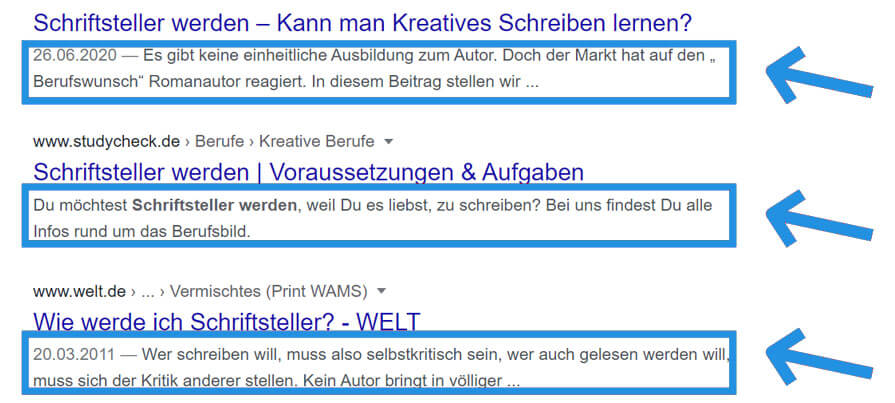
Here are a few examples of meta descriptions. If they are too long, they will be cut off like in the first and third snippet.
You can use our SERP Meta Generator to preview how your meta description will look. It also shows you if the text has the correct length for display in search results.
Meta data also includes image descriptions and alt texts. Google can better understand the content of an image if there is a descriptive caption. So, explain exactly what is shown in the image.
Create Stunning Content Design
Now comes the optimal finishing touch: content design. Readers don't want to see long walls of text; they prefer an appealing layout.
- Emphasize the most important information by placing it at the top of your webpage. The site's navigation should be simple and intuitive. A good design structure also helps Google recognize relevant content.
- The font should be easily readable and displayed correctly on any browser. If there's not too much contrast between the text color and the background, it's more pleasant to read.
- Ensure that your paragraphs are not too long and that there is enough white space between them for the eyes to rest.
- Design the text to be narrow so that users don't have to scan from left to right with their eyes constantly.
- Include images and graphic elements. Images are usually not overlooked when scanning the webpage and serve as reference points during reading. Visual elements also stay in memory longer and can convey emotions better.
- Similarly, videos work well. This medium is becoming increasingly popular and provides a creative way to present content.
- Elements such as jump links, info boxes, emojis, and subheadings help your users orient themselves.
- An expandable table of contents is also helpful. This allows readers to decide which section they want to read.
TIP: Opt for simplicity in design and don't overwhelm your readers with too much information. This will prevent confusion among your users.
Step 5: Publication and Review
After creating your text, you are not at the end yet. Now it's time for publication. Consider on which platforms and how you want to promote your content (e.g., via Google Ads).
TIP: For blogs, it's especially helpful to create an editorial plan. There, you can specify when each article should be published.
An SEO text is not static. You need to regularly review and optimize your content.
With rank tracking, you can check how your online presence compares to the competition. To see how your website is currently ranking, you can use specialized tools like our Google Ranking Check. This way, you'll immediately see your page's position and whether further optimization is necessary.
TIP: With KingCON, you can keep an eye on your competitors and see when they make changes to their content. The tool also allows you to conduct user surveys and A/B testing to check how your content is received by the target audience.
Stay informed about current trends and news related to your topic and continuously refine your work. Only then can you achieve lasting success.
Make It Easier with KingCON - The SEO Text Tool

The SEO text tool KingCON is specifically designed to provide optimal support for you as an SEO writer and take as much manual work off your hands as possible. The tool's user-friendly interface enables easy research and competitor analysis so that you no longer have to juggle between different tools.
During text creation, you'll have both search intent, relevant questions, and keywords in view, allowing you to fully focus on your content.
Interested? Then request a free demo now.
Conclusion
Creating the ultimate SEO text can be challenging, but with professional research and the right text structure, you can significantly simplify the process.
Here's a summary of the most important points:
- Put yourself in the shoes of your users and create content that is tailored to them.
- Your SEO text should captivate your readers and provide them with the greatest possible value in terms of content.
- Opt for simplicity and make it easy for your readers to consume your text.
- Regularly review your texts even after publication and refine your writing style.
By following these points, nothing will stand in the way of your successful SEO text.
Stay up to date with us: Our articles are continuously expanded and regularly updated.