
Table of Contents
SEO (Search Engine Optimization) - Search Engine Optimization
Author: Klaus Huber · Last updated: 24/02/2022
SEO (Search Engine Optimization) encompasses measures from search engine marketing with the aim of achieving the highest possible organic position on Google.
Search engine optimization includes all technical and content-related measures to improve discoverability in organic search, which means increasing rankings on Google.

SEO involves numerous on-page and off-page ranking factors that lead to user satisfaction and, ideally, to a top-ranking on Google.
In SEO, the task is to optimize all influencing factors perfectly for the target audience.
SEO from A-Z:
We explain what matters!
How does Google sort the search results list?
Google determines with a constantly optimized algorithm which page or landing page provides the greatest benefit and best user experience for the respective search or search intent - and thus determines the ranking.
SEO as a sustainable measure in search engine marketing!
Top-ranking results in Google search are very stable in their ranking position and are rarely replaced by other results. To get your site into a top placement, you must clearly and permanently demonstrate to Google and the algorithm that you have the ambition to replace a currently top-ranked site.

Why do I absolutely need SEO optimization?
Why is SEO marketing indispensable?
Google wants to place those results at the top of the search results list that offer the most benefit or the greatest advantage to the searcher. If you want to sell something, it's the same principle. You have to prove to potential customers among all your competitors that you have the best offer for them. (SEO marketing) Only then will they order from you.
Google wants to place those results at the top of the search results list that offer the most benefit or the greatest advantage to the searcher. If you want to sell something, it's the same principle. You have to prove to potential customers among all your competitors that you have the best offer for them. (SEO marketing) Only then will they order from you.
Since Google views and evaluates this from exactly the same perspective, i.e., through the algorithm, successful sales are synonymous with successful SEO. In other words, if you are not interested in presenting your customers with the best or most useful offer, then you don't need SEO either.
Example and further information.
Example:
Let's assume you are selling gold coins worth €1000 per coin and offer them on your website for €1. In this case, you already have the best SEO optimization you can imagine, just through the price. Bet that you will quickly be in a top position on Google for topics related to buying gold coins and similar subjects?! You can have the most terrible website design and still rank very well! Because in this case, the price outweighs any other consideration as a customer benefit; the customer does not care how good the website looks. They just want as many €1 gold coins as possible, as quickly as possible.
Practically applied
Since you probably don't want to offer far below market price and it is much better from an economic perspective to offer customers added value in areas such as performance and service, you should not rely on price alone to convince customers. (The exception, of course, is if your business model is based on offering the lowest prices)
Why these considerations determine success and failure
If you want to sell something or achieve something, you can only do so if potential customers are convinced that you offer the suitable offer, product, or service for them. So, it's all about satisfying potential customers. If you don't apply this principle, you won't be found in organic search, nor will you achieve anything through search engine advertising (SEA) because then you would be paying for customers to find you, and they will likely find a provider (offer) that understands and implements this principle correctly.
Why You Need SEO and What Well-Executed SEO Can Achieve!
SEO, or search engine optimization, is an essential component of any online marketing strategy. It involves optimizing your website to appear as high as possible in search engine results when people search for terms related to your business or products and services. Here are some of the key benefits you will achieve through a strong SEO strategy:
- Brand Building: A well-optimized website leads to a stronger brand and an improved online presence. Achieving a better ranking in search engine results exposes your website to a larger audience, leading to brand recognition and reputation building.
- Increased Online Sales: A well-optimized website generates more traffic, which in turn leads to more sales.
- Lead Generation for Service and Product Sales: A well-optimized website drives potential customers to your site, where they leave their contact information for future marketing activities.
- Increased Foot Traffic to a Local Store or Exhibition: Through local SEO measures, your website becomes more visible in local search queries, resulting in more visitors to your store or exhibition.
- Increased Website Traffic / Visitor Count: A better ranking in search engine results leads to more traffic on your website, increasing the visibility of your brand and company.
That's SEO: Conclusion
The purpose of SEO is to satisfy the searchers. And the one globally right SEO measure is SDSZ = Satisfy the searcher.
To learn why link building, reputation management, content marketing, and UX/UI design are part of SEO and how these measures can satisfy users, check out our article on "Learning SEO".
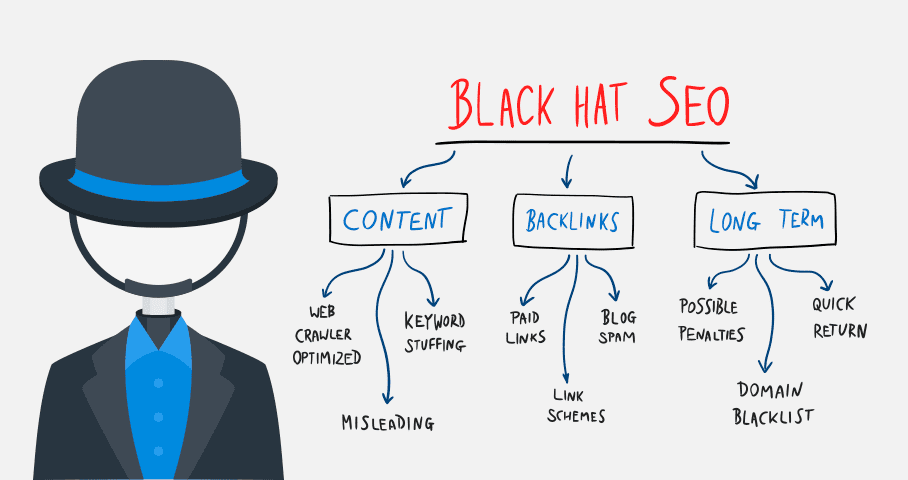
Black Hat SEO: Manipulative Google "SEO Measures"
Black Hat SEO refers to manipulative, "deceptive" SEO measures. It involves exploiting "flaws" or weaknesses in the Google algorithm to achieve better rankings. The Google search engine is continuously evolving to prevent fraudulent SEO practices. It is not worthwhile to engage in Black Hat SEO, and Google may even penalize such practices. It is assumed that using these manipulative techniques will ultimately worsen your ranking once Google discovers them.
SEO Must Be Profitable! Be Honest with Yourself and Your Goals!
Don't waste your money and energy on unattainable goals. If you find that competitors occupy the top 10 positions for relevant search terms that you cannot financially compete with, consider finding other keywords to target and build your ranking or try a niche related to your business idea to succeed online.
We can take a look at your project and assess your chances. It only "costs" you a phone call or an email, or you can reach out to us through our contact form to make an informed decision. Making a mistake could be costly. Your money, time, and motivation could be wasted. There's even a risk that you may begin to doubt your idea and yourself, even though you may have just chosen the wrong approach. For more information, see "What Does SEO Cost".
Warning! Alert!
You should carefully analyze whether your business idea can be successfully implemented on the internet; otherwise, you can lose a lot of money through "trial and error"!
SEO Metrics You Absolutely Need to Know!

Distribution of organic click-through rate on Google by position
Various studies have produced almost similar results. Ranking on the second page of Google search results is not profitable for your company. Additionally, you can see that even results below top 3 rankings in organic search receive very few clicks and visitors.
Overview of SEO Measures
On-Page
- Content optimization or creation (value-added content)
- Conversion optimization & sales psychology
- UX/UI design
- Image SEO (essential for products to provide visual selection)
- Trust-building
- Image-building / reviews
- Fast website (loading time optimization)
- Mobile SEO for optimal user experience on mobile devices
- Good and useful internal linking
- Local SEO for regional offers/services
Off-Page
- Link building (high-quality links)
- Trust-building
- Content marketing
- Social marketing
- Visibility through mentions / brand awareness
Doing SEO Yourself or Outsourcing It?
Whether it's better to do SEO yourself or have a professional agency handle it is a question many business owners ask. On one hand, there's the consideration of cost-saving and maintaining control over the process; on the other hand, there are concerns about making mistakes without comprehensive knowledge and experience. However, after careful consideration, we come to the conclusion that it's better to have a professional agency handle SEO. Here are some of the most important reasons:
- Time for your core business: SEO requires a significant amount of time and commitment. By delegating the work to a professional agency, you can focus on what you do best - your core business.
- SEO means hundreds of hours of learning: SEO is a complex subject that constantly evolves. To be successful, you need to invest a lot of time in understanding and mastering the latest techniques and trends.
- Practical experience is essential: SEO is a practice where practical experience is just as important as theoretical knowledge. A professional SEO agency has years of experience and can deliver secure and effective results.
- Identifying the right and correct sources for learning is not easy, and good SEO training also costs money. Therefore, SEO learning is NOT free in the end.
True SEO professionals have years of experience. Developing such expertise as a "side task" to your primary business purpose is almost impossible. Also, don't forget that Google only displays 10 organic search results on page 1, and the first 3 results are clicked on more frequently. What are the chances of obtaining these ranking positions with mediocre SEO knowledge?
In summary, it's better to have SEO handled by a professional agency rather than doing it yourself. This not only guarantees time and cost savings but also ensures higher quality and better results. Choose an experienced and reliable SEO agency that understands your needs and helps strengthen your online presence and promote your business.
Do You Need SEO for Your Website / Webshop?
Do It Yourself SEO
Learn SEO for beginners
SEO marketing
SEO tutorials
SEO guide
SEO ranking factors for Google
SEO glossary / lexicon
VS.Outsource SEO!
You don't want to become an SEO expert yourself?
You want to focus your time on your core business?
You want to be involved in SEO but need competent support?
SEO for Your Specific Requirements:
SEO for online shops SEO for websites SEO for WordPress SEO for Joomla SEO for blogs SEO for B2B SEO for SMEs (small and medium-sized enterprises) SEO for Shopify SEO for doctors SEO for lawyers SEO for real estate agents SEO for small businesses SEO for dentists SEO for beginners SEO for craftsmen SEO for photography SEO for B2B companies SEO for CEOs SEO for Google SEO for hotels SEO for Shopify SEO for local businesses SEO for attorneys SEO for startups SEO for tax consultants SEO for Bing SEO for businesses SEO for websites SEO for YouTube SEO for service providers SEO for agencies SEO for Amazon International SEO SEO for images SEO for companies SEO for Gambio SEO for real estate SEO for Jimdo SEO for Joomla SEO for law firms SEO for one-pagers SEO for professionals SEO for Shopware SEO for Typo3 SEO for videos SEO for webshops SEO for advanced users SEO for WordPress (in German) SEO for Wix SEO for mobile sites SEO for one-pagers SEO for WordPress blogs
Share?


Questions &
Answers
Answers
Thank you!