
Conversion Optimization:
All Important Details for Beginners and Advanced Users!

Klaus Huber
21.06, 2021
With targeted search engine optimization, you can reach the top positions on Google and generate heaps of traffic. But what if, despite all the traffic, the desired revenue is not achieved?
A high number of users is only beneficial if they also perform a conversion, meaning a specific action. In our article, we provide you with expert knowledge on conversion optimization, which can help you multiply the revenue of your online business.
What is a Conversion?
In online marketing, a conversion refers to a specific action taken on a website. This can be a purchase of a product, downloading software, or signing up for a newsletter, among others.
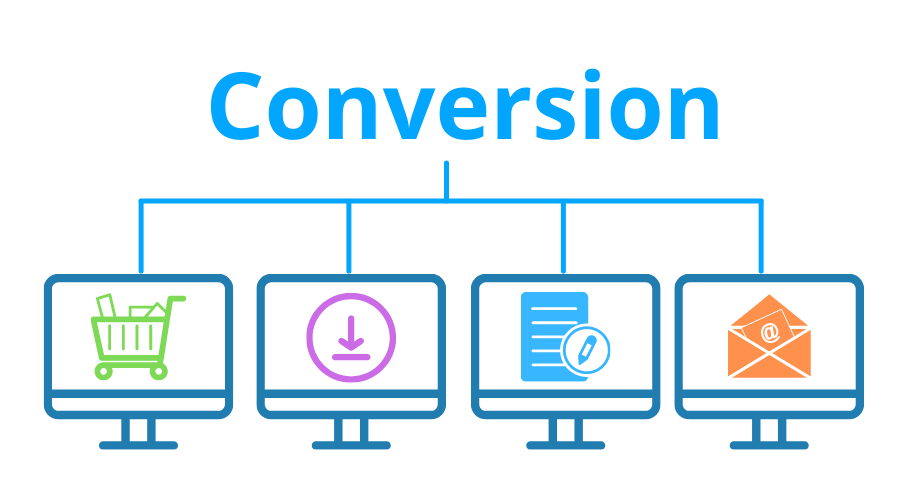
There are two types of conversions: macro-conversions and micro-conversions. Macro-conversions are the main business goals (e.g., completing a purchase). Micro-conversions are the intermediate steps leading to the main goal. Examples of micro-conversions include creating an account on an online shop or filling out contact information in a form.
The ultimate goal of any business is to generate as many of these conversions on the website as possible because that's how you can increase your revenue.
What is the Conversion Rate?
The conversion rate is calculated by dividing the number of conversions by the number of website visitors. It represents the percentage of visitors who take a specific action. The formula for calculating the conversion rate is as follows:
(Number of Conversions * 100) / (Number of Website Visitors) = Conversion Rate
For example, if a page receives 50,000 visitors in a month, and out of those, 1,500 perform a conversion, the conversion rate would be 3% (1,500 * 100 / 50,000 = 3).
The average conversion rate for a website is around 3 to 5%. Depending on your starting point, you can use this value as a rough guideline for your optimization efforts.
What is Conversion Optimization?
Conversion optimization refers to all marketing measures aimed at increasing the conversion rate.
A user typically goes through various stages on the way to the final conversion. This process is represented by the sales funnel.

At the beginning, many visitors come to the website (in this case, an online shop), but a large portion of them leave immediately or do not complete the purchase process. As a result, only a small portion makes it through the funnel and becomes a customer.
Therefore, companies must find out why users are leaving without converting. This can be due to personal reasons of the users (e.g., low buying intention), but often it is also due to poor website optimization.
Important: When it comes to conversion optimization, the entire purchase process must be considered as a whole. As a website owner, you are not just optimizing individual elements, but rather aligning the optimization along the entire customer journey of your users. This includes everything from the display in Google Ads to the actual purchase completion (and beyond).
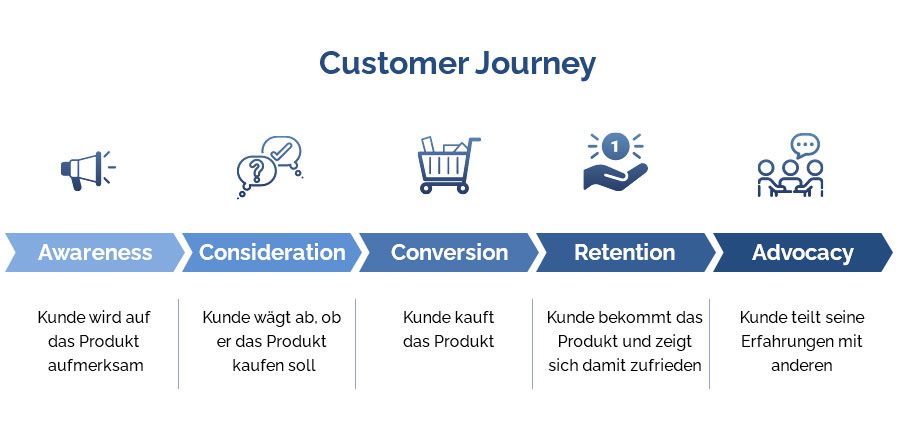
For successful optimization, you must always keep the needs and demands of your potential customers in mind. Only then can you take targeted actions and deliver exactly what they need. We have already shown you how to determine customer needs in our article on sales psychology.
Why is Conversion Rate Optimization Important?
Conversion optimization helps to improve the usability and overall quality of the website. Often, small changes can already convince a customer to complete a purchase.
Website owners get to know their customers better through an intensive analysis of the target audience, enabling them to offer an optimal shopping experience. This, in turn, increases the trust and desire to purchase among users.
How Do I Approach Conversion Optimization?
For conversion optimization, you have basically two options:
- Generate more visitors and more potential leads (new customers).
- Convert more existing visitors into customers.
Ideally, you should pursue both goals with conversion optimization: acquiring new customers and converting existing users.
We have gathered all the necessary details for an effective conversion optimization.
1. Analysis
To increase your conversion rate, you need to start by carefully examining the current status of your website and determining where your users are being deterred from converting.
User Behavior
First, you need to gain insight into the behavior of your users. The best tool for this is Google Analytics. In the left-hand menu bar, you can view important data about your users (e.g., conversions and demographic characteristics). You can individually review each subpage of your online presence here.
Identify which pages of your website have high bounce rates and, at the same time, a low time on page. This way, you can find out where your visitors are being deterred from completing the conversion. Faulty pages can be identified and improved more quickly.
Also, take note of the answers to the following questions:
- Through which search queries did users come to the website, and where do they start?
- On which pages do users spend a lot of time? Which elements receive a lot of attention?
- Which (mobile) devices and browsers do users use?
- What is the Buyer Persona? Which target audience am I addressing?
- On which page do users leave the website?
- Why do users visit the website? What goal do they want to achieve?
You can also view user behavior using heatmaps. Heatmaps represent user behavior by color-coding highly focused areas of the website. These heatmaps show you which areas of the website receive particular attention and which elements your users are most likely to click on.
TIP: You can create such a heatmap on the website EyeQuant.
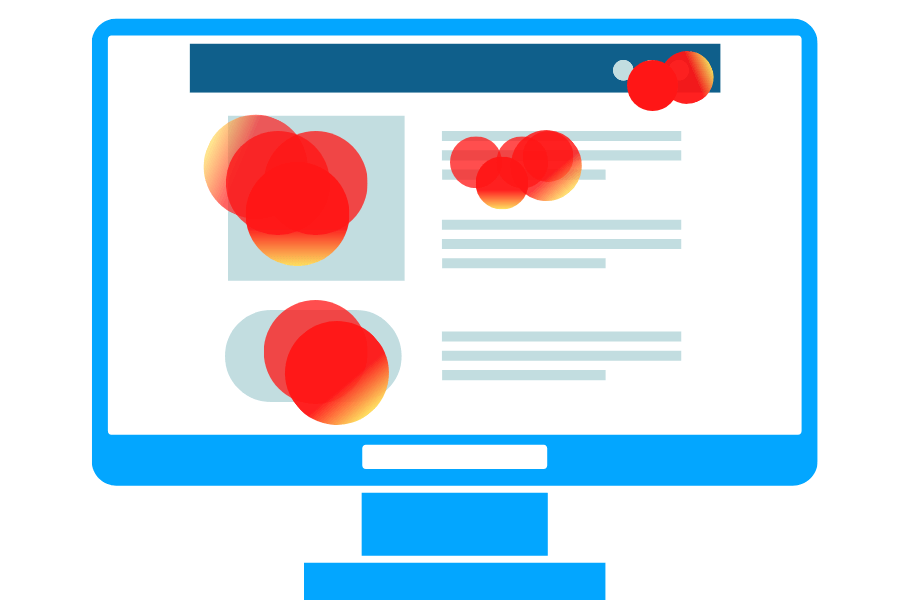
Collecting feedback is also an excellent source of improvement suggestions. By adding a survey tool, you gain direct insight into the wishes and expectations of your customers, allowing you to be more precise in your optimization efforts.
Content überprüfen
To increase your conversions, it is also essential to review the content on sales-relevant pages. This includes primarily the homepage, landing pages, individual product descriptions, and, if available, blog articles.
Take a look at your content and analyze whether it truly provides added value to your users. Do users find all the information they need? Do they know what benefits they can expect? Are the texts well-designed and easy to read? Are call-to-actions placed in the right locations?
TIP: To learn how to create high-quality content with a commercial offer, read our article on SEO Text Creation.
User Experience analysis
If users are not performing the desired action, it is often due to poor User Experience (also known as Usability). Ensure that the user interface is easy to use.
The more intuitively users can navigate through the website and the better you combine design with functionality, the more likely you are to increase the conversion rate.
- Is the navigation menu reduced to the essential elements and easy to understand?
- Are there interactive elements on the page?
- Do all searches and filters work properly?
2. Hypothesis Formation
To effectively make improvements to your website, the next step is to develop hypotheses about user behavior.
TIP: Use the "if, then, because" format to formulate your hypotheses. For example: If I allow guest orders in my shop, then more users will make purchases because they don't have to go through the registration process.
Formulate several such hypotheses and prioritize them based on their importance and likelihood of success. Based on these hypotheses, you can then develop a concept for optimizing your website and gradually test your theories.
3. Testing
Your identified optimization measures need to be tested for their effectiveness. The best way to do this is through A/B testing.
In A/B testing, two versions of a page are created and published. One group of your users is shown variant A, while the other group is shown variant B. The allocation is done at random.
Important: The test pages should differ in only one component so that you can precisely determine which content works better.

TIP: Ideally, you should conduct such A/B tests at regular intervals. This allows you to continuously improve your content.
4. Implementation
After identifying areas that require fundamental optimization, you can develop a concept for improvement. We will show you which areas you can effectively optimize.
Key Areas of Conversion Optimization
As a general rule, the user must immediately recognize that the website is relevant to them and that there are benefits awaiting them. The content must provide clear and transparent information that leads the user to the goal (conversion). To ensure that the user immediately knows the benefits of the page, place them above the fold.
Conversion rate optimization involves a variety of different measures. We have summarized the most important ones for you.
Landing Pages
Landing pages serve the sole purpose of persuading your users to take action. For this reason, they are one of the most important areas for conversion optimization. At the top of the list here is, of course, the content and design of the landing page.
- Does the user receive all the information without having to scroll too far down?
- Are call-to-actions strategically placed? Does the user know what to do next?
- Is the design simple and appealing?
- Are the benefits of the offer prominently displayed on the page?
- Are the ad texts engagingly written and relevant to the offer?
- Are the texts easy to read and the content well-organized?
TIP: You don't have to create countless new landing pages. It is sufficient to focus on the pages that already exist and perform relatively well.
Optimizing landing pages also involves attracting users' attention to your offer in the first place. Ensure that the title and meta description have the right length, are engagingly written, and arouse the user's curiosity.
To check how your meta data appears in the SERPs, you can use our Meta Description Generator. There you will also find tips on how to structure your meta description effectively.
Forms
Forms are necessary for collecting user contact information. To encourage users to fill out the forms, you should make the process as simple as possible.
When designing forms, avoid using unnecessary input fields, but also ensure that important questions are not left unanswered. If your users have to provide numerous pieces of information, filling out the form can quickly become tedious work.
Make registration and login forms as simple as possible. In many cases, name, password, and email address are sufficient:
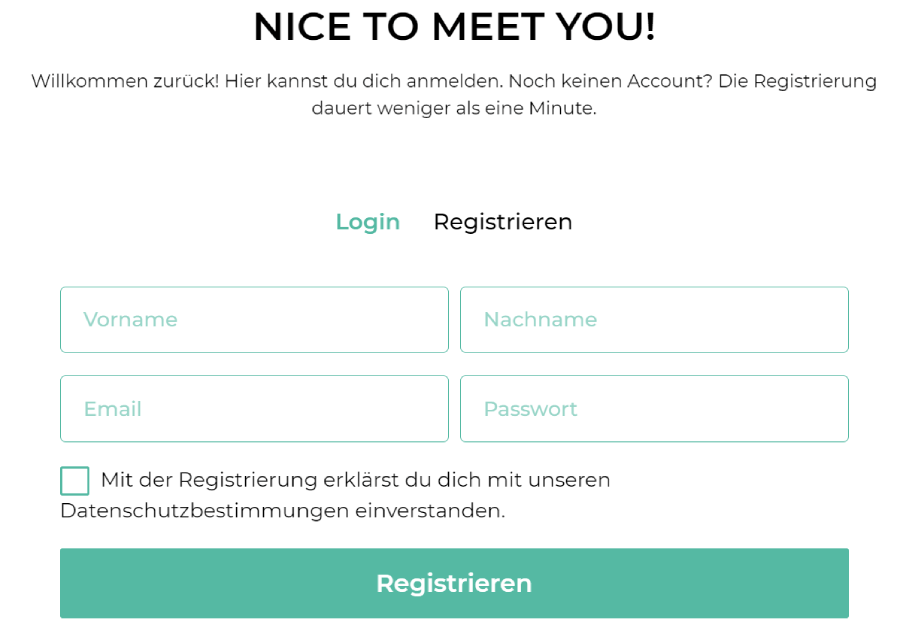
For longer or more complicated forms, consider adding info boxes and overlays to provide explanations to uncertain users. Mention why you are requesting a phone number or email address, as this will make users more willing to share their data.
Purchase Processes / Shopping Cart Optimization
This step is only applicable to e-commerce. If only a few users are adding products to the shopping cart or leaving the shop despite a filled shopping cart, alarm bells should ring.
Simplify the purchasing process as much as possible. Ensure a user-friendly checkout process and offer guest checkout options. Many users abandon their purchases because they don't want to go through the registration process. One-click ordering, like Amazon offers, can be particularly effective.
For multi-step checkouts, a progress indicator can be useful. It shows users how far they are from completing the purchase:

Also, use pop-ups to remind users of products in their shopping carts. This prevents users from leaving the shop before completing the purchase. At the very least, it provides an incentive to complete the purchase. However, avoid being too intrusive, as that could have the opposite effect.
You can also send emails to your users if items are left in their carts after leaving the website. If items are no longer in stock, offer to notify the customer via email when they are back in stock.
In general, once the customer is deep into the sales funnel (active checkout process), no distracting elements, such as shop navigation, should hinder them from completing the conversion. Only the content relevant to completing the purchase (e.g., price or product information) should be visible.
Trust and Social Proof
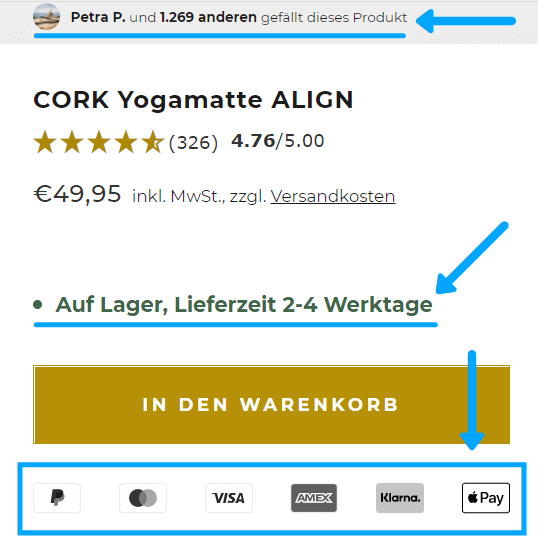
To turn visitors into customers, they must trust you. The best way to achieve this is through trust factors such as trust seals, certificates, or customer reviews, which should be prominently displayed on the website. Customer reviews, in particular, serve as strong selling points.
Offer different payment options that are relevant to your target audience, and show in advance which payment methods you accept. Different users may prefer or be able to pay in different ways.
Ensure that visitors are always informed about the current status of their order. Ideally, send an automatic confirmation email, which also provides information on when the product will be delivered. Include order tracking in the order overview. These measures are especially effective for uncertain customers.
This online shop for yoga accessories combines several trust factors in the product display, including prominently placed customer reviews and information about delivery time and payment options:
You can also generate trust by sharing your success story or introducing your team. Most websites have an "About Us" page or a dedicated section for this purpose.
In a few paragraphs, you can talk about the history of your company or your goals and visions. Customers tend to trust a brand more when they know the people behind it and can identify with the company's values.
Design and Layout
Design and layout adjustments can also improve your conversion rate. Many companies rely on the clever use of sales psychology. Create a simple website design and ensure that it is not only visually appealing but also functional.
Mobile Optimization
Since a significant portion of internet users access websites using smartphones and tablets, your website must be optimized for these devices' requirements. Ensure that all buttons and clickable elements work on mobile devices.
Keep in mind that users typically have limited time when browsing on smartphones. So, optimize loading times and ensure that the page is not too long. Endless scrolling can be cumbersome for most users.
SEA (Search Engine Advertising)
Regularly check if your Google Ads campaign aligns with your business goals and if the ad texts and landing pages are tailored to your offer.
TIPP: Set up conversion tracking through your Google Ads account. This allows you to monitor and measure conversions.
Email Marketing
Emails and newsletter campaigns are still important for retaining existing customers. Users who have subscribed to your newsletter are likely already interested in your offer. However, you can further encourage them with additional incentives to make a purchase:
- Show customers selected products that match their previous behavior.
- Highlight bestsellers or current sales in your shop.
- Attract users with coupons and discount offers.
It's best to create a plan defining how often you want to send emails and which offers should be prominently presented.
Gamification for Conversion Rate Optimization
Utilizing gamification elements can significantly increase your conversions. Gamification refers to the application of game elements in other contexts, such as operating an online shop.
The goal of gamification is simple: by introducing playful elements, our reward system in the brain is activated, and our motivation to complete a conversion increases unconsciously. Essentially, you can use gamification to encourage any desired customer behavior.
How can I apply this principle on my website?
For the application of gamification elements, you have several options. The most common ones are:
- Onboarding: Onboarding serves as an introduction to your website. This could be a short video tutorial on how to use the shop or a clear infographic about the most important contents of the site.
- Success experiences: Small achievements, such as reaching the minimum order value or a point system, activate our reward system and make us more willing to complete a purchase and continue using the shop.
- Progress: We humans love the feeling of accomplishment, even if it's something small. Especially in longer checkout processes, it's advisable to display a progress bar indicating how far the user has progressed in the order process. The same principle applies to small gifts that are unlocked based on the shopping cart value.
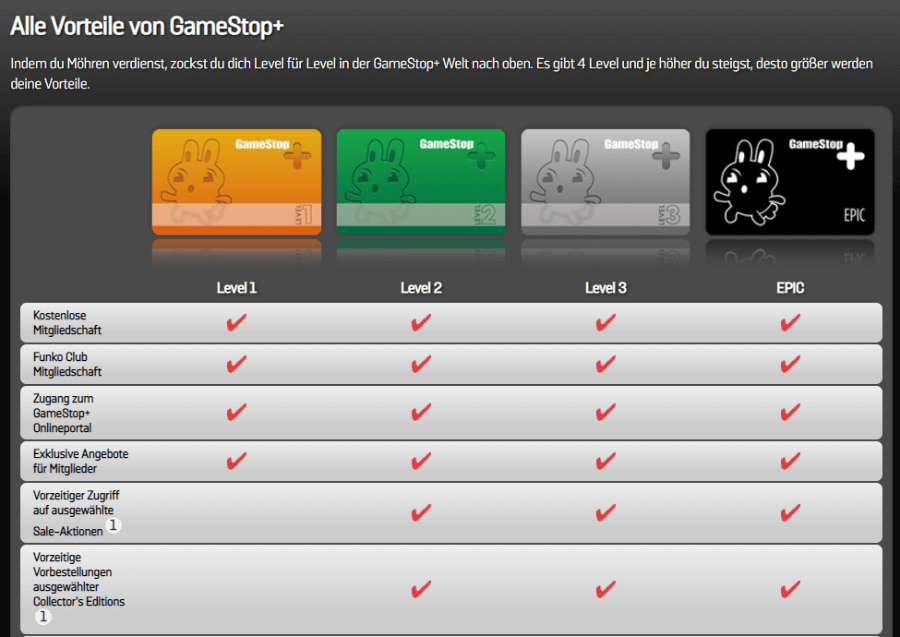
The company Game Stop strategically uses gamification elements for its customer memberships (fitting to the offered products). Members can earn "carrots" through purchases and sales, which lead to level upgrades and unlock specific benefits.
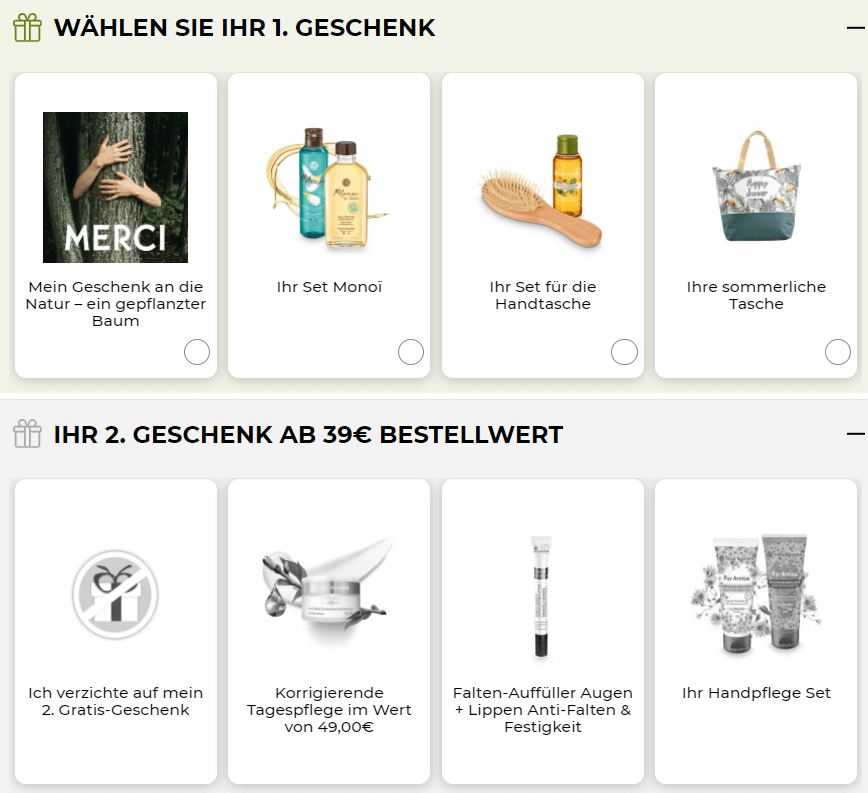
Also, gifts that are unlocked only with a specific shopping cart value serve as an incentive for completing the purchase.
Good gamification goes beyond simple point systems. It adapts to the website content and connects with users on an emotional level. When applied correctly, positive emotions are triggered in the customer, strengthening the relationship with the company.
Therefore, you can use gamification excellently to establish an intensive customer relationship and strengthen the brand recognition of your company.
Fazit
When it comes to conversion optimization, always consider your users' entire purchase process. Conversion optimization starts from the moment customers encounter your offer and essentially never ends. Even after achieving the desired conversion, your goal should be to continue engaging and retaining customers.
In our article, we have shown you how to identify gaps in your optimization and take measures to effectively increase your conversions. With our guide, successful implementation is now within reach.
Stay up to date with us: Our articles are continuously expanded and regularly updated.